
Search has changed forever. In 2026, zero-click searches – queries that deliver the answer directly on Google’s results page – now dominate. According to Similarweb data, between January and April 2026, 68.01% of U.S. Google browser searches ended without a click, redefining what SEO success means.
This report dives deep into verified zero click search statistics in 2026, the rise of AI Overviews, and how brands can adapt through Zero-Click SEO and Answer Engine Optimization (AEO) to thrive in this clickless era.
Key Takeaways
- 68.01% of U.S. Google searches ended without a click in early 2026. SparkToro and Similarweb found the zero-click rate increased from 60.45% in 2024, a rise of roughly 7.5 percentage points in two years.
- Searches producing any type of click fell 22.9% between 2024 and 2026. This includes organic results, paid ads, and clicks to Google-owned properties, showing that the shift extends beyond organic traffic alone.
- AI Overviews are becoming significantly more common. Recent research places their presence above 20% of Google searches, while BrightEdge found AI Overviews on roughly 48% of its tracked queries in February 2026, up 58% year over year.
- AI Overviews are reducing the value of the traditional number-one ranking. Ahrefs found that the top organic result receives approximately 58% lower CTR when an AI Overview appears.
- AI Mode is still a small share of overall Google search activity, but its audience is growing rapidly. Only 0.34% of searches entered AI Mode during January–April 2026, while Google separately reported more than 1 billion monthly AI Mode users and query volume more than doubling each quarter.
- AI-powered search sends substantially fewer external referrals. Similarweb reports referral rates of only 1.6–2.5% for AI Mode queries, compared with roughly 17–19% for traditional Google search.
- The traffic impact is becoming measurable at scale. Google’s share of traffic sent to a panel of more than 75,000 websites fell by about 22% between June 2025 and May 2026.
- Search discovery itself is beginning to shift toward AI. Similarweb’s January 2026 U.S. research found 35% of consumers considered AI tools most useful during product discovery, compared with 13.6% for traditional search engines.
- SEO in 2026 increasingly requires optimizing for visibility before the click. Rankings and traffic still matter, but AI citations, SERP presence, branded search demand, and answer inclusion now capture parts of the search journey that conventional click-based analytics miss.
What Is a Zero-Click Search?
A zero-click search happens when users get the answer they need directly on the Search Engine Results Page (SERP), without visiting any external site.
For example:
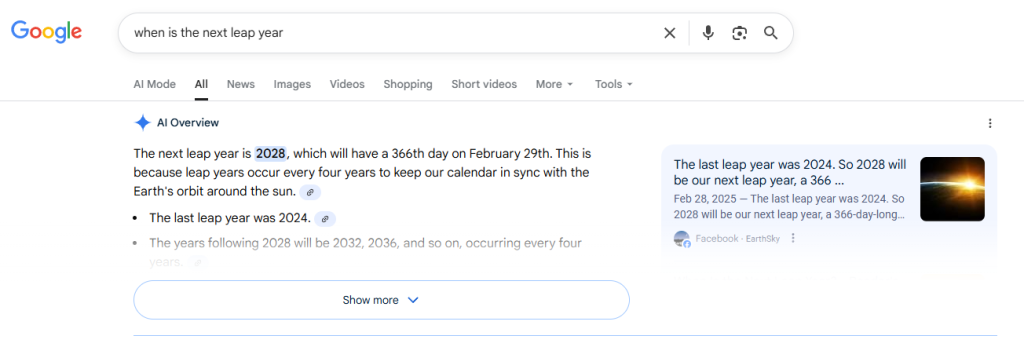
- Asking “when is the next leap year” provides the year 2028 instantly – no click required.
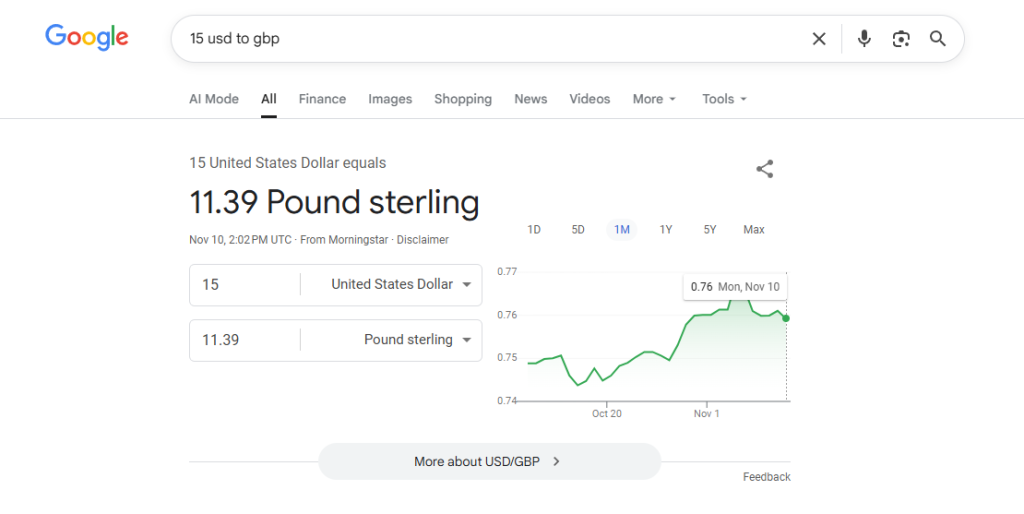
- Typing “15 USD to GBP” displays Google’s live currency converter – again, zero clicks.
These interactions, powered by Google’s AI Overviews, Featured Snippets, Knowledge Panels, and Direct Answer Boxes, now satisfy user intent before a visit ever occurs.
In other words:
“The search results page is no longer a gateway—it’s the destination.” — Limor Barenholtz, Similarweb (May 2025)
Zero-Click Search Statistics in 2026: Complete Analysis & Historical Evolution
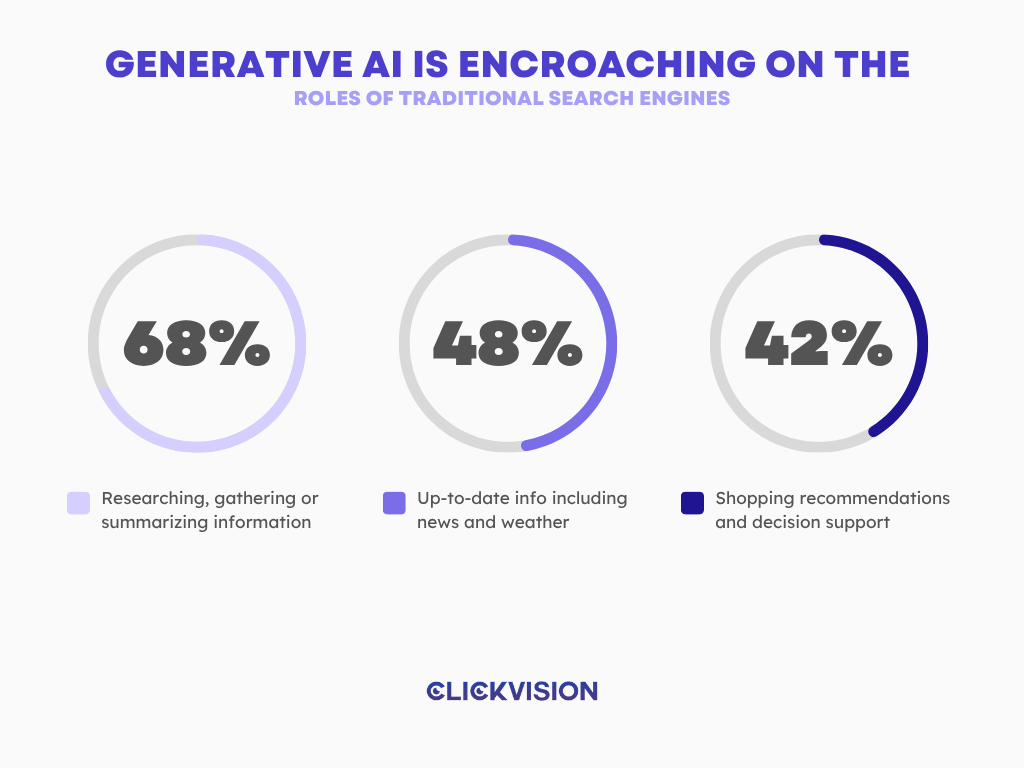
The rise of zero-click searches represents the most profound shift in search behavior since Google introduced featured snippets. As AI overviews, voice assistants, and instant-answer modules replace traditional links, understanding how this transition unfolded and what it means for visibility, has become central to every SEO and content strategy in 2026. This growing body of zero click search trends makes it clear how rapidly user behavior has moved away from outbound clicks.
According to Similarweb data, last year, more than 80% of all searches end without a single click, redefining what SEO success means.
A separate U.S. clickstream study published by Search Engine Land data provides a more specific 2026 benchmark. Between January and April 2026, 68.01% of U.S. Google browser searches ended without a click, up from 60.45% in 2024.
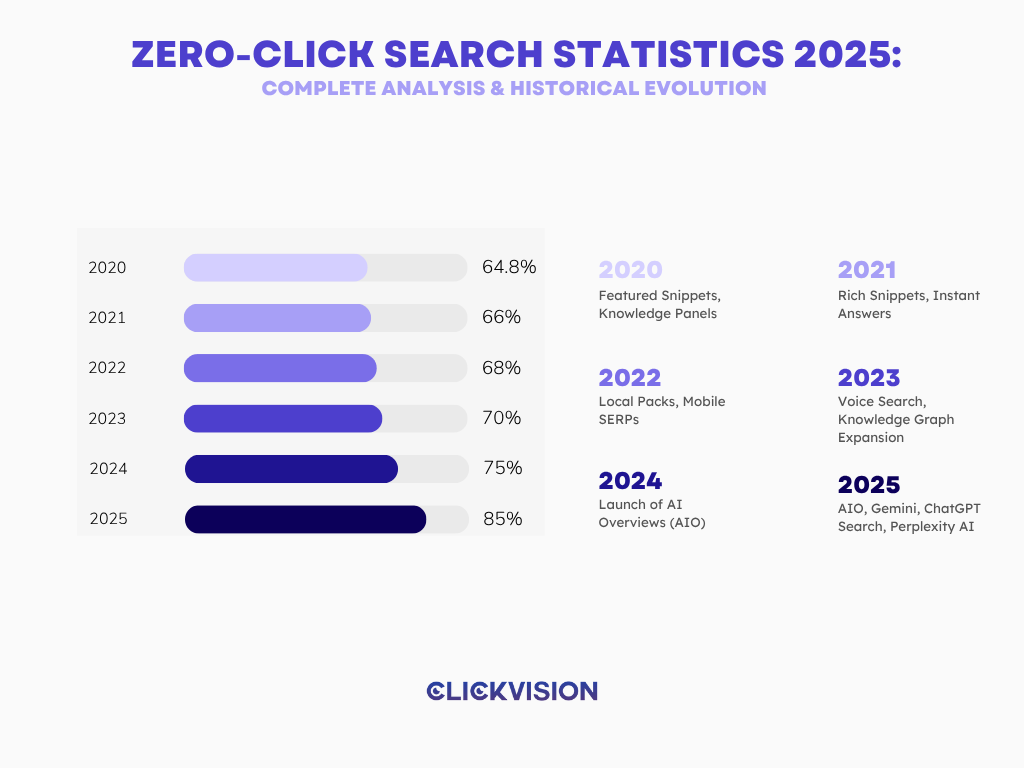
| Year | Global Zero-Click Rate | Primary Driver | Notable Feature Impact |
|---|---|---|---|
| 2020 | 64.8% | Featured Snippets, Knowledge Panels | Defined start of answer-engine behavior; most queries still drove outbound clicks |
| 2021 | ~66% | Rich Snippets, Instant Answers | Emergence of “calculator” / unit-conversion boxes; rise of “People Also Ask” |
| 2022 | 68% | Local Packs, Mobile SERPs | Majority of navigation and business look-ups resolved within Google Maps / Business Profile |
| 2023 | 70% | Voice Search, Knowledge Graph Expansion | Voice-assistant responses replace fact queries; definitions and bios go zero-click |
| 2024 | 75% | Launch of AI Overviews (AIO) | Early AIO tests show ~40% CTR decline for informational keywords |
| 2025 | 80–85% | AIO, Gemini, ChatGPT Search, Perplexity AI | Multi-modal answers dominate; factual, news, and local searches increasingly resolved in-SERP |
| 2026 | 68.01% in the U.S. browser panel | AIO expansion, repeat-search behavior, AI-powered SERPs | Similarweb/SparkToro found clickless searches up 7.5 percentage points from 2024 while searches producing any click fell 22.9% |
Primary Data Sources: SparkToro (2020, 2021), Similarweb (2025), Inner Spark Web Report (2022), BrightEdge + Semrush (2023), Ars Technica + Search Engine Land (2026), MarTech + Single Grain (2025).
Methodology note: The 2026 figure is based on U.S. Google browser searches from January through April 2026 and is not directly comparable with every global figure in the historical timeline. SparkToro also cautions that its historical studies used different clickstream providers and panels.
Key Insight: Searches triggering AI Overviews now show an average zero-click rate of 83%, while traditional queries (without AIO) average around 60%.
In other words, 8 out of 10 users now get their answer directly inside the search interface.
Explore our comprehensive SEO services to learn how CLICKVISION helps brands increase search visibility, authority, and qualified organic growth in 2026.
What the Data Really Shows (2020–2025)
The numbers in the timeline for Zero-Click Search Statistics in 2026 reflect more than growth — they reveal a structural shift in how search engines handle user intent. From 2020’s feature-based snippets to 2026’s AI-driven summaries, each year represents a measurable reduction in the “open web” share of traffic.
2020–2021: The Foundation of Zero-Click Behavior
Research from Similarweb showed that by mid-2020, 64.8% of Google searches ended without any click-through, as users increasingly found answers in knowledge panels, definitions, and instant results.
By 2021, SparkToro’s trend report noted a rise to roughly 66%, driven by expanded “People Also Ask” boxes and the first generation of calculator and conversion modules. This era established Google’s long-term objective: satisfy the query inside the SERP rather than directing traffic outward.
2022–2023: The Mobile and Voice Acceleration Phase
In 2022, the shift became device-driven. Mobile search accounted for more than 63% of total Google queries, and local-intent searches (e.g., “near me”) produced up to 78% zero-click outcomes, according to Similarweb’s mobile trend data. Google Maps, Local Packs, and Business Profiles became de-facto micro-sites.
By 2023, voice search adoption surpassed 50% among U.S. adults (Pew Research, 2023), while BrightEdge documented a 25–30% drop in organic clicks for informational queries as Knowledge Graph and voice-assistant results replaced simple fact lookups.
2024: AI Overviews Reshape CTR Models
When Google’s AI Overviews (AIO) launched widely in 2024, the impact on click-through rates (CTR) was immediate. Ars Technica reported ~40% average CTR decline on informational and research-intent keywords once AIO summaries appeared.
At the same time, Word Steam’s zero-click index climbed to 75%, with news and publisher traffic seeing the steepest losses. This was the year when “position 1” stopped being synonymous with “visibility.”
2025: The AI Consolidation Year
By 2025, Semrush recorded AI Overviews appearing on 13.14% of all U.S. desktop queries, double the January figure. BrightEdge confirmed that longer, conversational or question-style queries (8+ words) trigger Google AI Overviews far more often than shorter queries, making long-tail, question-based content increasingly important for SEO.
Meanwhile, Similarweb’s aggregated data shows that for AIO-triggered results, the median zero-click rate reached 80%, averaging around 83%. Traditional queries without AIOs still hovered near 60%. This aligns with broader zero click search statistics showing that AI-driven SERPs now resolve most informational intent without users ever needing to leave the page.
Adding to that, platforms such as Google Gemini, ChatGPT Search, and Perplexity AI now satisfy informational intent conversationally, compounding Google’s trend. Collectively, these developments point toward a web where 80–85% of all user interactions remain within a closed search ecosystem.
Not every ChatGPT interaction replaces a Google search: drafting or editing text can serve a different purpose. Keep that distinction in mind when interpreting broader ChatGPT statistics.
2026: Zero-Click Growth Accelerates Again
The first major U.S. clickstream study of 2026 shows that clickless behavior has accelerated further. SparkToro analyzed Similarweb desktop and mobile browser data from January through April 2026 and found that 68.01% of Google searches ended without a click, compared with 60.45% in its comparable 2024 benchmark.
That is an increase of roughly 7.5 percentage points, or 12.5%, in two years. At the same time, searches generating at least one click of any kind fell 9.51 percentage points, equivalent to a 22.9% decline.
The 2026 study used Similarweb’s U.S. desktop and mobile web panel and weighted the analysis approximately two-thirds mobile and one-third desktop. It excludes searches conducted through Google’s dedicated mobile search application.
60.45%
Zero-Click Rate in 2024
U.S. Google searches
68.01%
Zero-Click Rate in 2026
Jan–Apr U.S. browser searches
+7.56 pp
Increase in Zero-Click Searches
2024 → 2026
A smaller share of searches producing clicks does not, by itself, establish that the total number of clicks has fallen; overall search volume also matters. Explore our Google Search statistics for broader research on Google Search.
The Real Impact of Zero-Click Search Statistics in 2026
Traditional Google Search
17-19%
Queries Generate External Referrals
Google AI Mode
1.6–2.5%
Queries Generate External Referrals
AI Mode sends external referrals at a fraction of traditional Google’s rate.
The implications go far beyond lost traffic metrics.
- Attribution becomes opaque: With fewer outbound visits, analytics platforms capture less behavioral data, complicating ROI models.
- Brand exposure shifts to inclusion: Visibility now depends on how frequently your content or entity is referenced inside AI summaries.
- E-E-A-T signals drive algorithmic trust: Content freshness, factual consistency, and structured data determine whether your information is chosen for display.
- Voice, local, and multimodal queries expand the gap: Non-visual interfaces (smart speakers, car dashboards, wearables) produce zero-screen zero-click behavior, accelerating the trend.
AI Mode adds another layer to this shift. Similarweb reports that AI Mode generates external referrals on only 1.6–2.5% of queries, compared with approximately 17–19% for traditional Google search. The difference illustrates how conversational search interfaces can generate significant search activity while sending comparatively little traffic to external websites.
Zero-Click Impact Metrics
| Data Point | Stat / Source | Interpretation |
|---|---|---|
| Open-web clicks per 1 000 searches (US) | 360/1000– SparkToro 2024 | Only 36% of searches generate any external click. |
| Zero-click rate for news queries | 69% (May 2025)– TechCrunch | Publisher visibility reduced by ~13 pp in one year. |
| AI Overviews prevalence | 13.14% of queries (Mar 2025)-Semrush | Indicates aggressive AIO rollout for complex queries. |
| CTR drop on informational queries | ≈ 40% decline-Ars Technica 2024 | Confirms reduced engagement even for high-rank pages. |
| Zero-click share on mobile local searches | 78%-Similarweb 2023 | Most interactions occur through call or map actions. |
| Searches generating any click | −9.51 percentage points / −22.9% from 2024 to 2026– SparkToro / Similarweb | Click-producing search journeys are shrinking alongside rising zero-click behavior. |
| Google traffic share across 75,000+ participating domains | −8 percentage points / ~−22% from Jun 2025 to May 2026– Ahrefs tracker via SparkToro | Shows the zero-click shift translating into measurable downstream traffic loss across a large website panel. |
The second 2026 traffic figure requires context. The Ahrefs panel includes more than 75,000 domains that opted into aggregated tracking, so it should not be treated as a representative sample of the entire web. Still, the measured decline shows that the change in search behavior is translating into substantial traffic effects for tens of thousands of active websites.
The data confirms that zero-click is not a temporary anomaly – it’s the new baseline.
Marketers who treat AIOs, snippets, and local packs as distribution layers rather than threats are already gaining visibility. Winning in 2026 means optimizing for answer inclusion, entity clarity, and structured credibility, not just keyword rankings.
How Americans and Europeans Stopped Clicking
The global search landscape has reached a tipping point. Data from SparkToro, Datos, and Similarweb shows that the once-reliable flow of traffic from Google’s search results to external websites has dramatically weakened. Across regions and devices, more searches now end on Google itself – without a single click to another domain.
The U.S. Shift: Google’s Walled Garden Expands
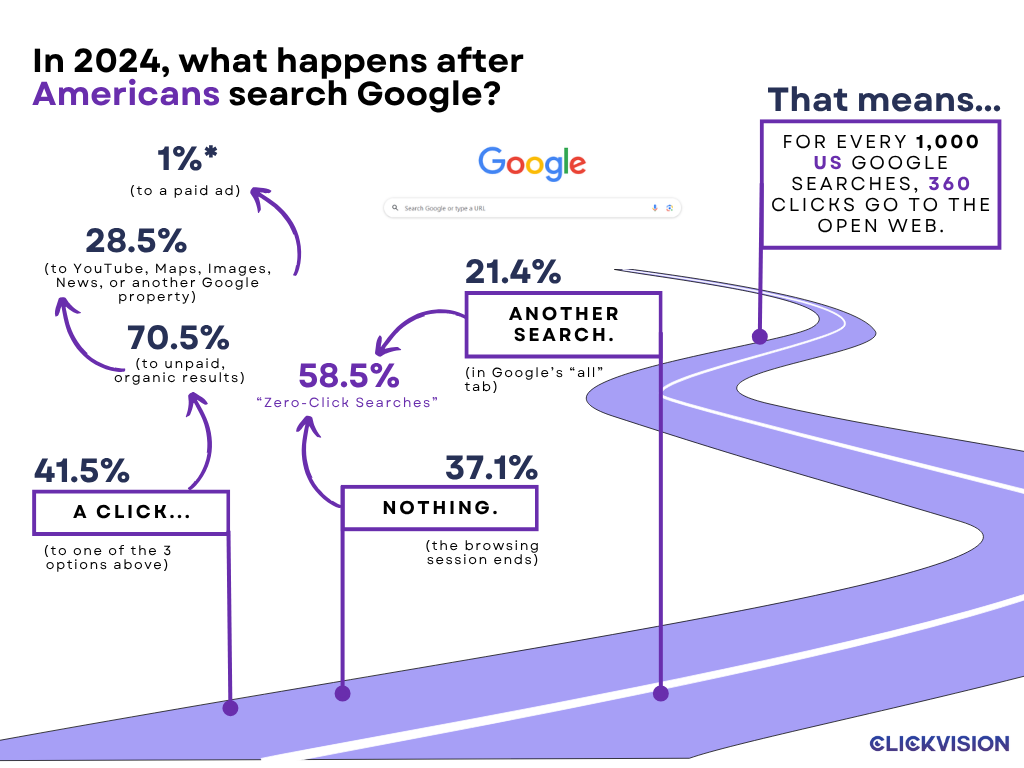
In the United States, the trend toward zero-click behavior accelerated sharply through 2024. Roughly 41.5% of all searches generated at least one click, but a deeper look reveals how much of that activity now stays within Google’s ecosystem. Of all clicks made, 70.5% were directed to organic listings, while 28.5% were captured by Google-owned properties such as YouTube, Maps, and Images. A mere 1% led to paid ads, reflecting the limited share of traditional advertising engagement.
The more striking figure, however, is what doesn’t happen. 58.5% of searches ended with no click at all— a complete session without user interaction beyond the results page. This represents a fundamental behavioral change: users are finding answers directly through AI-generated summaries, snippets, and knowledge panels rather than visiting external websites. In practical terms, for every 1,000 Google searches in the U.S., only about 360 clicks make it to the open web. The remaining majority either find answers instantly or refine their query within Google’s interface.
The newer 2026 SparkToro/Similarweb study shows how quickly that behavior has continued to change. By January–April 2026, 68.01% of U.S. Google browser searches ended without a click. The percentage of users performing another Google search also increased 7.2 percentage points from 2024, reinforcing the idea that more search journeys now continue inside Google rather than moving to an external website.
When using SEO vs. PPC statistics to compare channels, distinguish paid ads’ share of all search clicks from campaign CTR, which divides ad clicks by ad impressions.
Europe: Slightly More Open, But Still Zero-Click Dominant
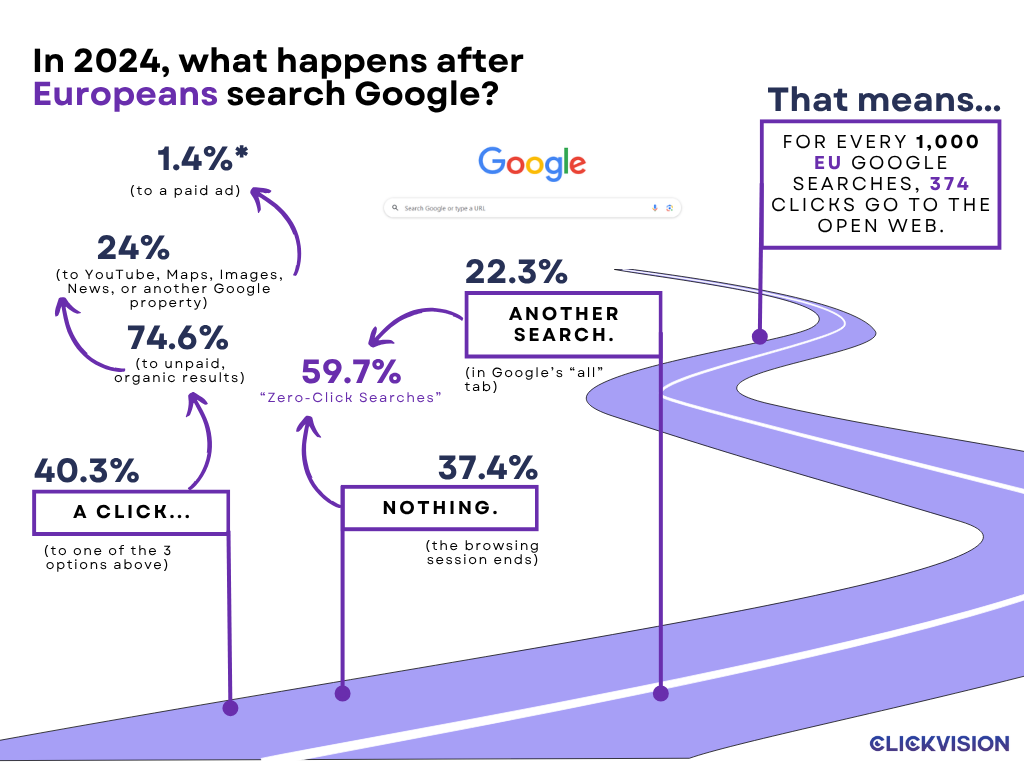
European users exhibit a similar, though marginally less severe, pattern. In 2024, 40.3% of Google searches resulted in at least one click, and 74.6% of those clicks led to organic results. Meanwhile, 24% of interactions went to Google-owned products, and 1.4% to paid ads. Despite these regional nuances, the overall picture remains nearly identical: 59.7% of searches across Europe end without a single external click.
For every 1,000 searches performed in the EU, roughly 374 clicks reach independent websites, compared to 360 in the U.S. Analysts suggest that the difference may be attributed to the Digital Markets Act (DMA), which pressures Google to present a fairer mix of external sources within search results. However, even with regulatory influence, the open web’s share of engagement continues to erode year over year.
Mobile Dominance and AI Integration
By early 2025, zero-click searches had moved from trend to standard behavior. According to the SEO Bazooka 2025 report, around 60% of all global searches now result in no external click. Mobile searches are driving this transformation: on phones, 77% of queries end without visiting another website, compared to 46.5% on desktop, as reported by Up & Social (2025). With AI summaries, widgets, and voice results instantly answering queries, mobile users simply have fewer reasons to leave the search results page.
Google’s fully conversational AI Mode remained a relatively small part of total search activity during the first four months of 2026. SparkToro and Similarweb found that only 0.34% of Google searches transitioned into AI Mode during the January–April measurement period.
Its audience, however, is expanding quickly. At Google I/O 2026, Google reported that AI Mode had surpassed 1 billion monthly users, while the volume of AI Mode queries had more than doubled every quarter since launch. The contrast between its large user base and its 0.34% share in the early-2026 clickstream study shows that AI Mode was still emerging as a search behavior during that measurement window rather than being the primary cause of the broader zero-click increase.
0.34%
Google Searches Entering AI Mode
Jan–Apr 2026
1B+
Monthly AI Mode Users
Google I/O 2026
2×+
Quarterly Query Growth
Since Launch
Year-over-Year Changes: 2024 → 2025
Analysis from Search Engine Land highlights how the pace of zero-click adoption has intensified. Between March 2024 and March 2025, the U.S. saw its zero-click rate rise from 24.4% to 27.2%, while the EU and UK increased from 23.6% to 26.1%. Over the same span, organic click-through rates (CTR) fell to 40.3% in the U.S. and 43.5% in the EU/UK, as more users interacted with AI-generated content directly in the SERP. Clicks to Google-owned properties grew steadily to 14.3% in the U.S. and 12.6% in the EU/UK, indicating Google’s growing dominance over user pathways.
The newer 2024–2026 comparison makes the longer-term movement even clearer. SparkToro’s Similarweb analysis found the U.S. browser zero-click rate rising from 60.45% in 2024 to 68.01% in early 2026. Because SparkToro’s 2024 and 2026 studies use different clickstream providers, the comparison should be interpreted cautiously, but the direction of change is consistent with the broader reduction in external search traffic.
Zero-Click by Query Type
Zero-click behavior changes significantly depending on search intent. Informational queries are far more likely to end on the SERP, while transactional searches still drive more users to external websites. Digital Applied’s 2026 analysis shows why intent matters when deciding whether a query should be optimized for clicks or for visibility within search results.
| Query Type | Zero-Click Rate | AI Overview Trigger Rate | Click Quality Index |
|---|---|---|---|
| Informational | 74.3% | 35%+ | High (research intent) |
| Navigational | 56.8% | 4% | Very high (brand intent) |
| Commercial investigation | 51.2% | 22% | Very high (purchase intent) |
| Transactional | 39.4% | 6% | Highest (conversion intent) |
| Local | 68.7% | 18% | Moderate (Maps absorbs clicks) |
Informational Query Breakdown
- 86% Definition queries (“what is…”)
- 91% Factual lookups (dates, stats)
- 72% How-to queries (simple)
- 53% How-to queries (complex/multi-step)
- 48% Comparison queries
- 44% “Best” + category queries
- 38% Research/analysis querieses
Transactional Query Breakdown
- 32% Product searches (specific)
- 41% Product searches (category)
- 28% “Buy” + product queries
- 37% Service provider searches
- 43% Pricing and quote queries
- 44% Software/SaaS searches
- 36% Booking and reservation
Source: Digital Applied, Zero-Click Search Statistics 2026: Complete Data Guide.
A customer who calls directly from a business listing can become a lead without ever visiting the website. Our Local SEO statistics bring together broader research and figures about local search.
Industry-Specific Zero-Click Rates
Zero-click rates also vary by industry. Sectors built around informational searches tend to see higher zero-click rates, while industries with stronger commercial and transactional intent still generate more website visits. Digital Applied’s 2026 analysis shows the widest differences across definitions, weather, healthcare, finance, SaaS, travel, and ecommerce.
| Industry / Vertical | Zero-Click Rate | YoY Change | Primary Driver |
|---|---|---|---|
| Definitions / Dictionary | 89% | +3% | Direct answer boxes |
| Weather / Local info | 82% | +2% | Google Weather widget |
| Health / Medical | 78% | +8% | AI Overviews expansion |
| Finance / Stocks | 74% | +5% | Finance widgets, AI Overviews |
| Recipes / Food | 71% | +6% | Recipe cards, AI Overviews |
| Technology / SaaS | 62% | +7% | AI Overviews, comparison panels |
| Legal services | 58% | +4% | Featured snippets, AI Overviews |
| Real estate | 53% | +3% | Map pack, listing previews |
| B2B software | 44% | +5% | AI Overviews (comparison queries) |
| Travel / Booking | 41% | +2% | Google Flights/Hotels integration |
| eCommerce / Retail | 38% | +3% | Shopping results, product panels |
Source: Digital Applied, Zero-Click Search Statistics 2026: Complete Data Guide.
The strongest year-over-year growth appears in sectors where AI Overviews have gained more visibility. Health increased by 8%, technology by 7%, and recipes by 6%, while ecommerce and travel saw smaller gains. The difference largely comes down to search intent: informational queries are easier to answer directly in the SERP, while users searching for products, bookings, or services are still more likely to visit a website.
The “Technology / SaaS” and “B2B software” labels can overlap, so the figures should not be assumed to compare mutually exclusive business categories. For research focused on this sector, see our SaaS SEO statistics.
Why Zero-Click Searches Are Rising
1. AI Overviews Take Over SERPs
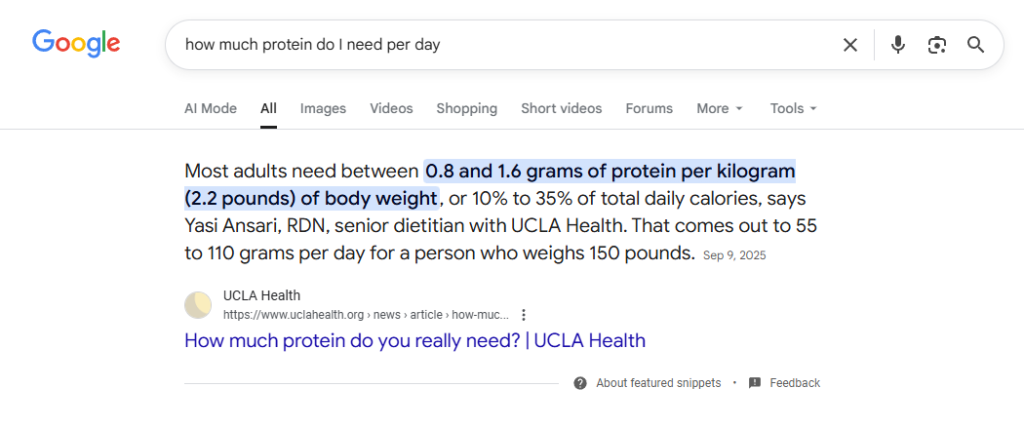
Google’s AI Overviews (AIO) now appear on roughly 13% of all U.S. desktop queries (Semrush, March 2025). They summarize insights from multiple trusted sources—Healthline, Forbes, Wikipedia, etc.—into conversational, citation-based responses.
Examples:
- Searching “how much protein do I need per day” returns a full AI Overview citing multiple health publishers with a visual breakdown—no click required.
- Typing “how to clean solar panels” produces a step-by-step guide inside the Overview, blending content from The Spruce and Home Depot.
- Asking “best AI tools for marketers 2025” shows a curated list compiled from HubSpot, ClickUp, and MarTech—users never leave Google.
AI Overview coverage expanded considerably after that March 2025 measurement. SparkToro’s June 2026 research, citing Ahrefs, reports AI Overviews on more than 20% of Google searches.
A separate BrightEdge dataset shows an even broader footprint within its own tracked keyword set. Using BrightEdge AI Catalyst and its Generative Parser, the company found that AIO presence increased from roughly 30–31% of tracked queries in February 2025 to approximately 48% in February 2026. That represents a 58% year-over-year increase.
The 20%+ and 48% figures should not be treated as competing estimates of exactly the same population. They come from different keyword sets and measurement methodologies. Together, however, they show substantial expansion in AI Overview visibility during 2025 and early 2026.
Stat Insight: BrightEdge’s 2025 study found CTRs drop by 40% on queries that trigger AIOs versus traditional SERPs.
Newer research suggests the effect has intensified. Ahrefs re-ran its AI Overview CTR study using December 2025 data and published the results in February 2026. Across 300,000 keywords, Ahrefs found that the presence of an AI Overview correlated with a 58% lower average CTR for the position-one organic result.
→ Users now complete research, comparisons, and decisions within the search results – websites merely serve as cited sources.
20%+
Google Searches With AI Overviews
2026 research
~48%
BrightEdge Tracked Queries With AIOs
February 2026
−58%
Position #1 Organic CTR
When an AI Overview Appears
2. Direct Interaction Tools
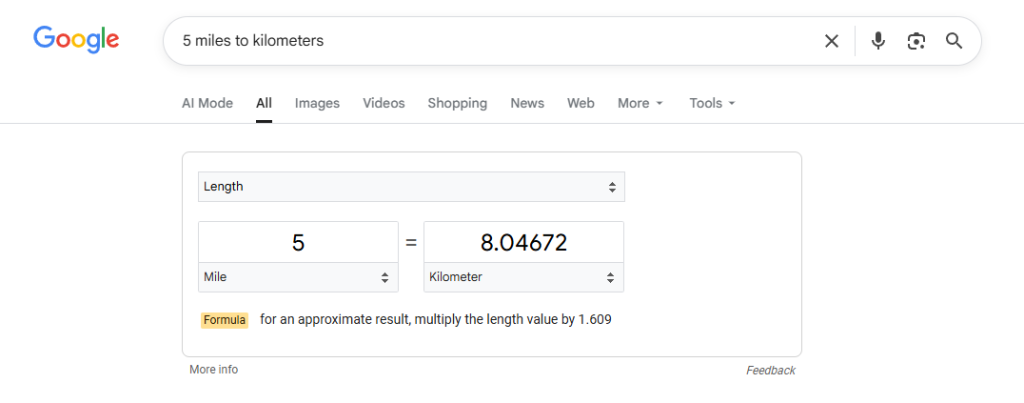
Built-in calculators, time converters, and weather widgets have become everyday examples of zero-click design. Similarweb’s analysis shows that search categories such as finance, weather, and conversions have among the highest zero-click rates (up to 100%).
These tools let users perform actions instantly – removing the need to visit an external website.
Examples:
- Searching “100 USD to EUR” displays a live currency converter with real-time exchange rates.
- Typing “5 miles to kilometers” activates Google’s inline conversion tool.
- Typing “time in Tokyo” shows an interactive clock with local time zones.
According to SparkToro, more than 20% of all daily searches globally contain paid ads, and nearly all of them are resolved via these in-SERP tools—cementing zero-click as the default for factual or utility-driven intent.
3. Knowledge Panels & Instant Facts
Google’s Knowledge Graph powers panels that instantly deliver structured entity data – covering everything from people and brands to products and locations. These panels now resolve a majority of fact-based searches.
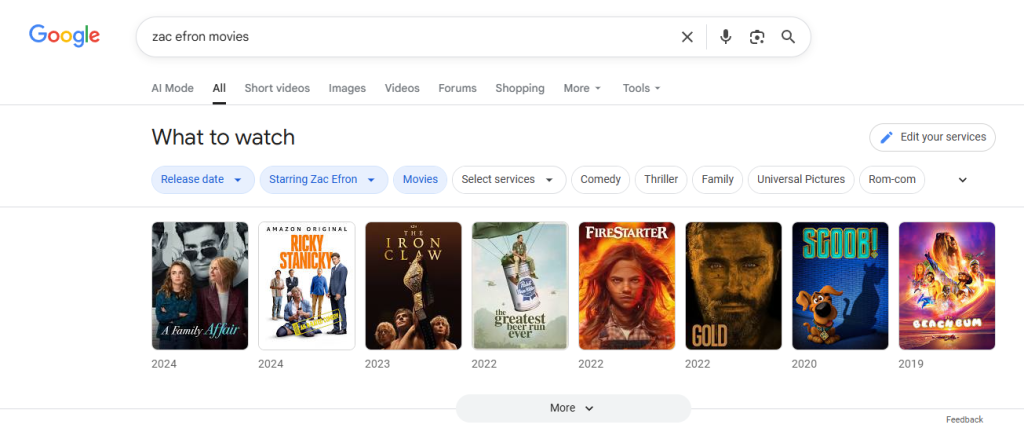
Examples:
- Query “CEO of Microsoft” instantly displays Satya Nadella with image, title, and company bio.
- Searching “population of Brazil” returns the latest data from the World Bank alongside a visual growth chart.
- Typing “NVIDIA revenue 2024” shows a financial snapshot with earnings data from Google Finance.
- Query “Zac Efron movies” reveals a carousel of his filmography without visiting IMDb.
The MarTech 2025 Visibility Report highlights that entity-based results now occupy over 25% of first-page real estate. This means content structured around schema, Wikidata alignment, and E-E-A-T (Experience, Expertise, Authoritativeness, Trust) signals is more likely to surface in these instant panels.
Visibility Insight: appearing within a Knowledge Panel now generates more brand impressions than traditional top-10 rankings.
4. People Also Ask (PAA) Expansion
Google’s People Also Ask has evolved into an interactive micro-FAQ engine. It now populates dynamically based on query context and user behavior, expanding to show related questions with inline answers.
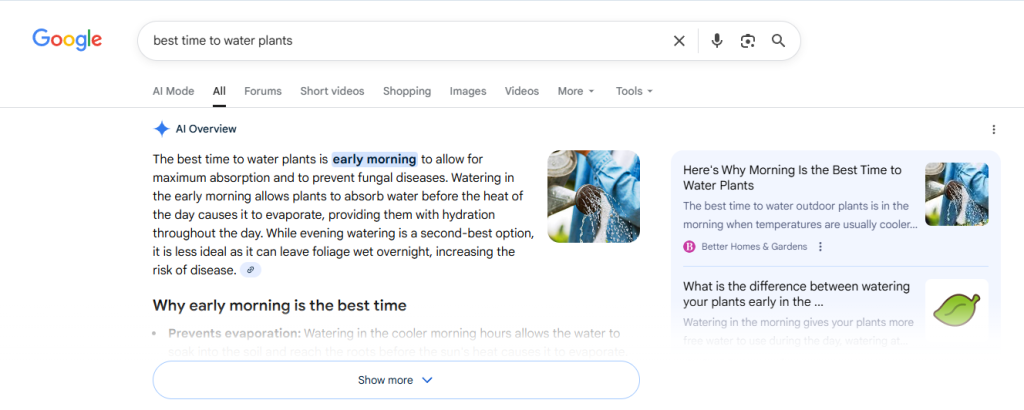
Examples:
- Searching “how to write a cover letter” expands to reveal “What should you avoid in a cover letter?” and “How long should it be?”—each sourced from top-ranking HR blogs.
- The query “causes of climate change” displays nested follow-ups like “How much does CO₂ contribute?” and “Can climate change be reversed?”
- Typing “best time to water plants” surfaces multiple question boxes, each showing content from gardening authorities like The Spruce and Gardeners’ World.
According to Briskon (2025), PAA boxes appear in about 75% of mobile and desktop searches ( 92% of SERPs for informational searches), absorbing an estimated 15–20% of total search interactions. Users typically expand multiple questions per query, fulfilling their curiosity without ever clicking away.
Content Strategy Tip: Optimizing for PAA visibility – using question-based headings, FAQ schema, and concise answers – remains one of the most effective zero-click SEO tactics in 2025.
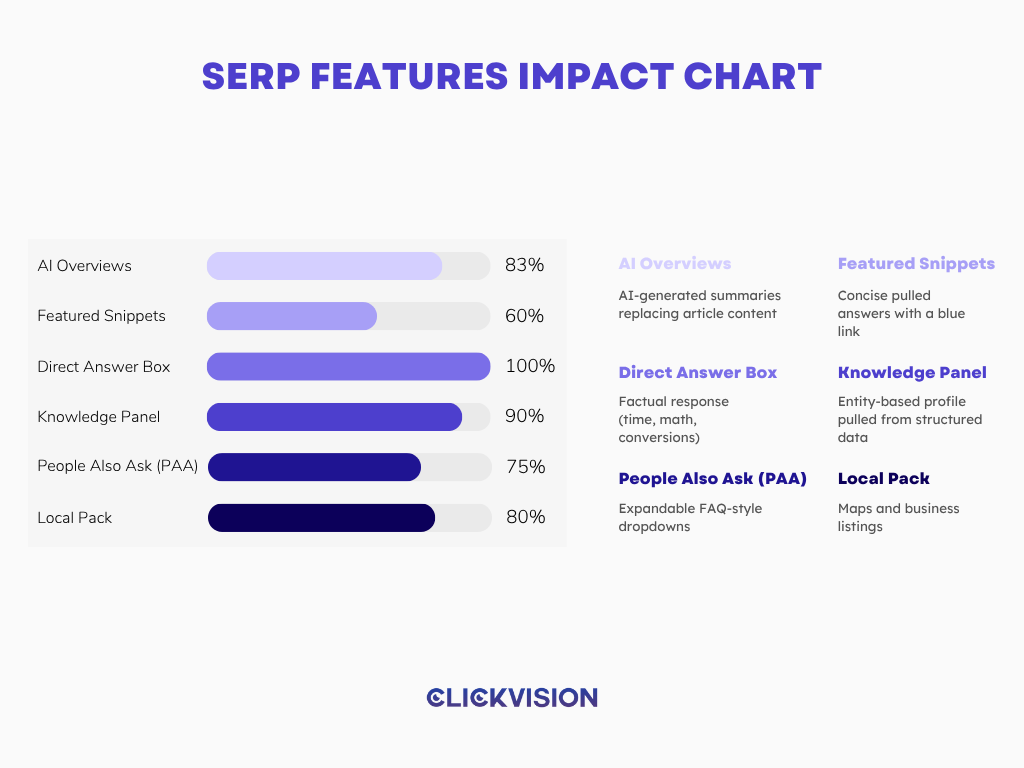
How SERP Features Drive the Rise of Zero-Click Searches (2025 Data)
| SERP Feature | Description | Zero-Click Impact (Average) | Example |
| AI Overviews (AIO) | AI-generated summaries replacing article content | 🔺 +83% | “What are zero-drop shoes?” |
| Featured Snippets | Concise pulled answers with a blue link | ~60% | “How to write a cover letter” |
| Direct Answer Box | Factual response (time, math, conversions) | 🔺 100% | “Grams to pounds” |
| Knowledge Panel | Entity-based profile pulled from structured data | 🔺 90% | “Clint Eastwood” |
| People Also Ask (PAA) | Expandable FAQ-style dropdowns | 70–80% | “What is zero click SEO?” |
| Local Pack | Maps and business listings | 70–85% | “Pool fence installer near me” |
Measuring Visibility in the Zero-Click Era (AEO Metrics)
| Metric | Description | Measures |
| Answer Inclusion Rate (AIR) | How often your content appears inside AI-generated answers | Algorithmic trust & citation frequency |
| Entity Presence Index (EPI) | Frequency of brand/entity recognition in AI & search | Brand knowledge graph strength |
| Source Authority Score (SAS) | Quality, structure, and freshness of your content | AI-read trustworthiness |
| AI Citation Frequency (AICF) | Number of times your brand is quoted in AI results | Influence across generative platforms |
These metrics now define success in the zero-click era.
They measure visibility before the click – not after.
How to Use Zero-Click SEO in 2026
1. Identify Zero-Click Keywords
Use Similarweb, Ahrefs, or Semrush to find terms with high zero-click probability (like “meaning,” “convert,” “time in,” “definition”).
2. Structure Content for Extraction
- Write answers in clear 40–60 word paragraphs.
- Use H2 and H3 headings that mirror user queries.
- Add FAQ schema and HowTo markup.
3. Optimize for AI Overviews
- Depth: Add context, not fluff.
- Trust: Cite credible data sources (e.g., Pew, Statista).
- Structure: Use bullet points, tables, and key takeaways.
4. Refresh and Republish Regularly
AI engines favor freshness and recency. Update content quarterly to maintain inclusion in AI Overviews.
5. Track Visibility, Not Just Traffic
Monitor AI mentions, schema validation, and branded search growth via tools like Google Search Console + Similarweb Visibility Reports.
Search Visibility Optimization
Target AI Overviews and featured snippets
Strengthen entity signals
Structure answers for extraction
Track branded search visibility
AI Citation Optimization
Publish original data and research
Use clear source attribution
Build topical authority
Track AI citations and mentions
Click Quality Optimization
Prioritize commercial queries
Optimize pages for high-intent visitors
Track conversion value, not only traffic
Diversify acquisition beyond Google
Why This Matters for Marketers
As the latest zero click search statistics in 2026 confirm, for marketers, the zero-click era has rewritten the rules of visibility. Traditional metrics like organic clicks and website sessions no longer tell the full story of brand performance. In a world where Google’s AI Overviews, knowledge panels, and featured snippets answer questions before a user ever leaves the results page, visibility now lives inside the search experience – not beyond it.
A brand can dominate the conversation even without earning the click. When your content appears in an AI-generated summary, your expertise is being read, referenced, and trusted within the SERP itself. That presence builds authority in ways that traffic data alone cannot capture.
This evolution marks the rise of Answer Engine Optimization (AEO) – the new bridge between traditional SEO and AI-driven discovery. AEO focuses not just on ranking for queries, but on being cited, summarized, and referenced by the engines that increasingly deliver answers, not links. Using AI to produce or optimize content is different from earning inclusion in AI answers; our AI SEO statistics provide broader research on AI’s role in SEO.
In this environment, marketers must measure success through visibility, trust, and inclusion within AI-generated content. It’s no longer about where users go – it’s about what they see, who they trust, and which voices shape their understanding before they ever click.
As MarTech (2025) summarized it best:
“The next era of marketing will favor those who measure what matters most: being known, being credible, and being chosen.”
Conclusion
Zero-click searches aren’t killing SEO – they’re redefining it. The data behind zero click search statistics in 2026 shows that visibility now depends less on where you rank and more on how your content is surfaced within AI-driven summaries, voice results, and generative SERPs.
The brands that adapt fastest to this clickless ecosystem will dominate across AI search, voice, and conversational engines.
To win in 2026 and beyond, focus on visibility metrics, not just clicks. Build content that’s designed for extraction and citation. Measure trust, authority, and entity recognition—these are the new signals of success in a zero-click world.
Because in 2026, visibility isn’t about who ranks highest – it’s about who’s cited most often.