
If you’re still treating local SEO like an optional marketing add-on, the local SEO statistics for 2026 data set makes one thing painfully obvious: you’re already behind. Nearly every behavior that drives real-world revenue — discovery, buying decisions, store visits, phone calls, and search engagement — now flows through local search. Consumers are searching constantly, acting fast, and choosing businesses that show up first and show up strong. Mobile dominates, “near me” intent is exploding, and Google’s local ecosystem is controlling more customer journeys than ever. These numbers don’t just highlight a trend; they expose a reality: local search is where your customers decide who wins and who disappears.
A. General Local Search Behavior & Demand
A.1. Local intent & local discovery
- The top-ranking pages on search engines have an average age of 2.6 years. (seo.com)
- Most people (96%) turn to the Internet to discover local businesses. (seo.com) (BrightLocal)
- 4 in 5 consumers use search engines to find information about local businesses. (Red Local SEO)
- 46% of Google searches have local intent. (Search Engine Roundtable)
- Local queries account for half of Google’s two trillion annual searches. (Moz)
- Local SEO statistics show that 78% of local searches result in an off-line conversion. (Search Engine Land)
- Local SEO statistics show that 72% of consumers who search local businesses online end up visiting stores within a five miles radius. (Forbes)
- Local and organic searches account for 69% of all digital traffic. (Milestone)
- Local searches contribute 22.6% of overall website traffic. (Milestone)
- Local traffic is highly engaging, with an average of 3.92 pages viewed per session, outperforming other top-performing channels. (Milestone)
A.2. Frequency of local search usage
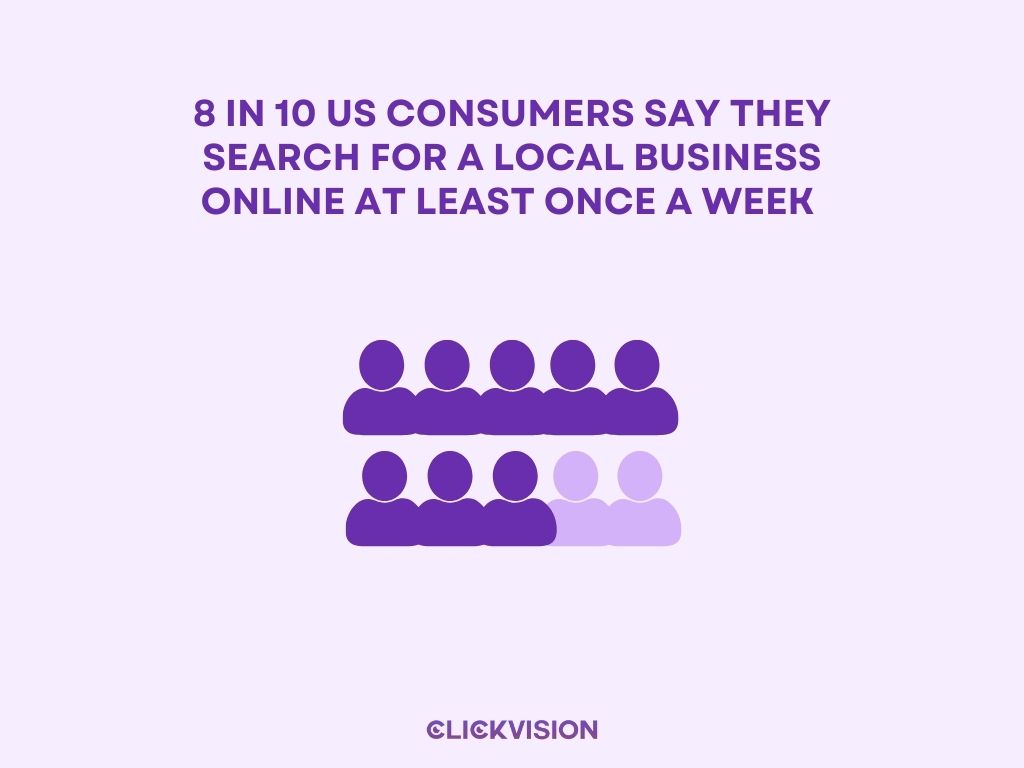
- 80% (8 in 10) of US consumers search online for local businesses on a weekly basis, and 32% search daily. Local SEO is critical for all small businesses including gyms, salons, auto repair shops, and food trucks. (Soci Consumer Behaviour)
- 32% of American consumers report looking up information about local businesses online at least once or multiple times a day. (SOCi)
- One-third of online users search for local businesses daily. (Statista)
- 40% of consumers claim to have searched for a local business to see its opening hours at least a few times per month. (Brightlocal)
- 39% of consumers claim to search for local business information at least once a month to check if it’s dog-friendly, child-friendly, or accessible. (Brightlocal)
- 29% of people search for local businesses at least once a week. (Safari Digital)
- One in three people use their phones to search for products before looking for a nearby store. (99Firms)
B. “Near Me” & Local Intent Detail
- 1.5 billion “near me” searches happen every month, indicating local intent. That’s 50 million local searches every single day. Every hour, 2 million people are looking for businesses in their area. (Krofile) (seo.com)
- Searches including “near me” or “close by” have increased by 900% in the past two years. (Synup)
- 8. “Near me” mobile searches grew increased by 136% last year. (Think With Google)
- 76% of consumers who search for “near me” visit a business within a day. (Google)
- 76% of voice searches are related to “near me” and local inquiries. This trend is expected to triple as users increasingly seek direct information about local businesses. (Invoca)
- When searching “near me,” 60% of smartphone users click on the first two or three results. (JS Interactive)
C. Mobile Local Search & Conversions
C.1. Mobile usage share
- 84% of local searches are conducted on mobile. (SEO Design Chicago)
- 60% of mobile users have reached out to a business directly using the search results. (Google)
- 30% of smartphone searches include a location. One in three mobile searches has local intent. (Synup)
C.2. Mobile search → visits/actions
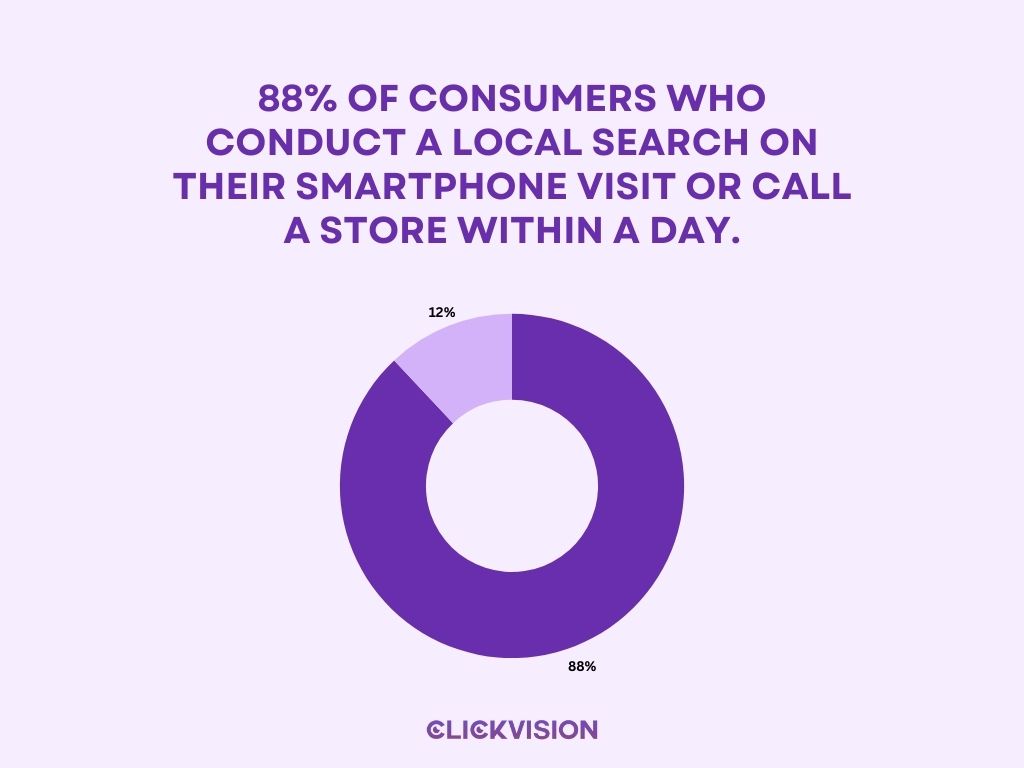
- 88% of consumers who conduct a local search on their smartphone visit or call a store within a day. (SEOProfy) (Google)
- 76% of people who conduct a local search on their smartphone visit a physical place within 24 hours, and 28% of those searches result in a purchase. (Think With Google)
- Around 2 in 10 local searches on a smartphone led to a purchase within a day. (Google)
- 80% of local searches convert into customers. Compare that to the 2-3% conversion rate of most online advertising. Local search intent is pure gold. (seo.com)
- 4 out of 5 mobile searches lead to a purchase, often within hours. (SEOProfy)
- Mobile users are 5x more likely to call a business directly from search results. Mobile searches drive immediate phone calls, not just website visits. (Krofile)
- 60% of smartphone users contact a business directly from search results. (Think With Google)
- Local mobile searches are growing 50% faster than overall searches. (SynUp)
Mobile vs Desktop Local Search Behavior:
| Behavior | Mobile | Desktop | Key Difference |
| Search Frequency | 58% | 42% | Mobile dominates |
| Call Rate | 5x higher | Baseline | Mobile drives calls |
| Visit Rate | 78% | 45% | Mobile drives visits |
| Purchase Rate | 78% | 52% | Mobile converts better |
| Time to Action | 24 hours | 2-3 days | Mobile acts faster |
D. Google Maps, Local Pack, and Platforms
D.1. Google Maps & 3-Pack usage
- 70% of consumers use Google Maps to look for nearby businesses. (seo.com)
- 88% of people use Google Maps to find local businesses, while 12% opt for Apple Maps. (BrightLocal)
- About 1 in 5 consumers runs local searches directly in Google Maps. (Search Engine Journal)
- Most clicks in local search results go to the local pack (44%), followed by organic results (29%) and ads (21%). (SEOProfy)
- 68% of users click on one of the top three results in Google’s 3-Pack for local searches, making it crucial to rank there. (Search Atlas)
D.2. Platform preference
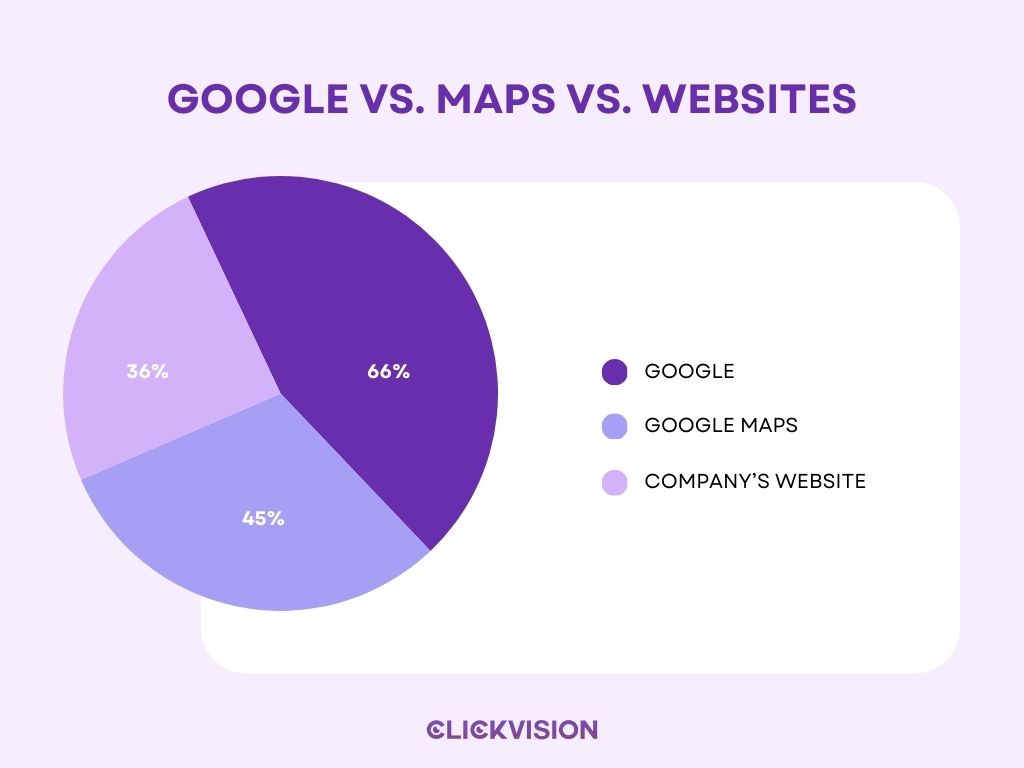
- When people research local businesses online, they tend to trust Google the most (66%), followed by Google Maps (45%) and the company’s website (36%). (BrightLocal)
- Among younger consumers aged 18 to 24, the top platform used for local searches is Instagram (67%), followed by TikTok (62%) and Google Search (61%). (Backlinko)
- Among Apple users, 58.6% prefer to use Google Maps vs. 26.3% for Apple Maps when searching for local businesses. (Brightlocal)
- Google Maps drives 30-40% of local business discovery. (Semrush)
- 77% of users turn to Google for local business information. (Statista)
E. Google Business Profile (GBP) / Google My Business
E.1. Usage, completeness, and impact
- Customers are 70% more likely to visit a business with an optimized Google Business Profile. So, Google Business Profile listings with complete information get 7x more clicks. Detailed profiles dramatically outperform incomplete ones. (seo.com)
- Customers are 2.7 times more likely to trust a business if they come across a complete local listing or Business Profile on search and Google Maps. (SEOProfy)
- Businesses that include photos on their Google Business Profiles tend to get 42% more direction requests on Google Maps and 35% more clicks to their websites compared to those that don’t. (AIT)
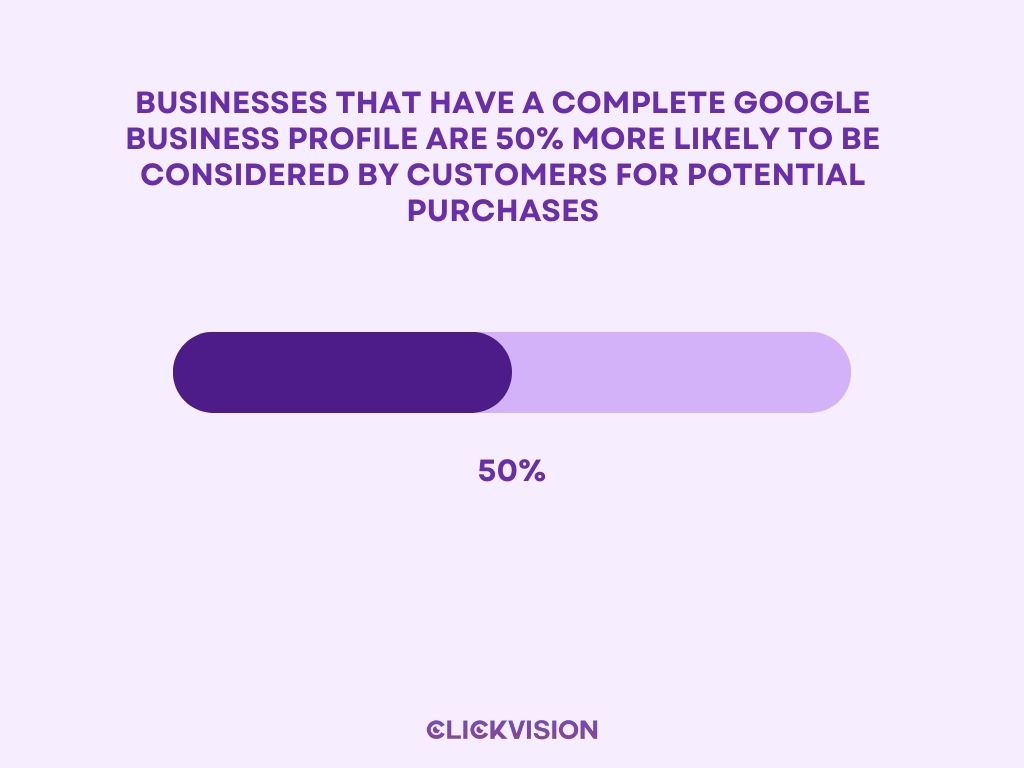
- Companies that maintain a complete Google Business Profile have a 50% higher chance of being considered by customers for future purchases. (SEOProfy)
- Businesses with a Google Business Profile are 94% more likely to be seen as trustworthy. (Gitnux)
- On average, a local business’s Google Business Profile receives over 1,200 views monthly. (seo.com)
- Verified businesses receive over 21,643 views each year in Google searches. (Search Atlas)
- Over half of consumers will call a business directly from their profile. (RedLocalSEO)
- Businesses receive around 595 calls a year, or about 50 calls a month, from their verified Google Business Profiles. (SEOprofy)
- 45% of businesses receive appointment requests through their Google Business Profile (GBP). (Publer.io)
- 64% of consumers turn to Google Business Profiles for important contact information. (Linkedin)
- 56% of actions taken on Google Business Profiles lead to website visits. (Red Local SEO)
- Local companies with contact information receive 94% of calls on weekdays. (Publer.io)
- About 56% of customers expect to find the most accurate information on the company’s website. (99Firms)
E.2. Adoption / neglect
- 56% of local businesses have not yet claimed their Google My Business listing. (WytLabs)
- 75% of marketers think that the use of Google Business Profile features affects local search rankings (MOZ)
- 32% of local SEO professionals believe that Google Business Profile is the most essential factor to rank well in the map pack. (BrightLocal)
F. Reviews & Reputation
F.1. Review consumption & behavior
- 89% of consumers say they’re more likely to choose a business that responds to all reviews — whether positive or negative. (BrightLocal)
- Nearly half of consumers (49%) put as much trust in online reviews as they do in personal recommendations from their friends or family. (BrightLocal)
- 90% of marketers think that reviews directly impact local search rankings in the map pack. (MOZ)
- 75% of consumers indicate that they “always” or “often” check online reviews while looking into local businesses. (Brightlocal)
- 98% of people read online reviews at least occasionally before deciding on a local business. (BrightLocal)
- 36% of users check Google reviews to guide their purchase decisions. (Statista)
- 91% of consumers say that reviews for local branches influence their overall opinion of larger brands. (BrightLocal)
- 17% of U.S. online shoppers consistently check reviews before making a purchase, and 38% find them “very important” in their decision-making process. (Statista)
- Among internet users aged 25 to 34, 36% rely on online reviews to research brands and products. (Statista)
- 63% of people say they would lose trust in a business if they mostly see negative reviews. (BrightLocal)
- 90% of shoppers read reviews before making a purchase. (The Media Captain)
- 94% of people say reviews have deterred them from choosing a business. (Luisa Zhou)
- 88% of customers say reading an online review influenced their purchasing decision. (Luisa Zhou)
- Displaying reviews online can boost conversions by 270%. (Luisa Zhou)
- 75% of people feel more positive about using a local business after reading a favorable review. (BrightLocal)
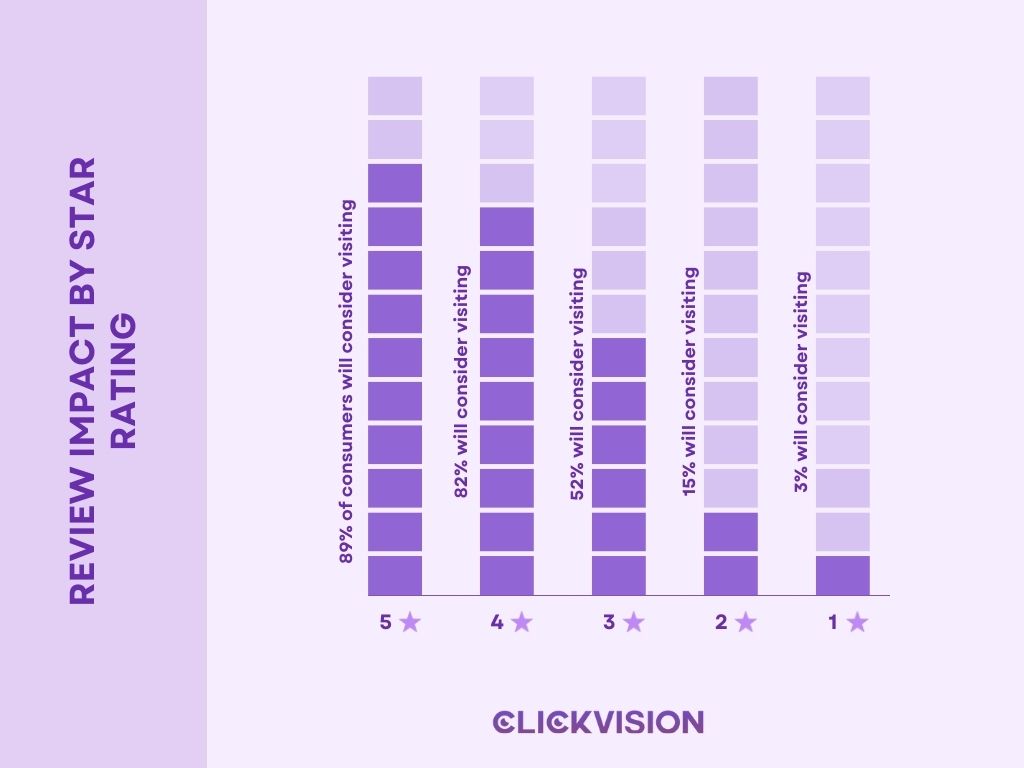
- Review impact by star rating:
- 5 Stars: 89% of consumers will consider visiting
- 4-4.9 Stars: 82% will consider visiting
- 3-3.9 Stars: 52% will consider visiting
- 2-2.9 Stars: 15% will consider visiting
- Below 2 Stars: 3% will consider visiting
F.2. Volume, recency, and thresholds
- Companies with over 200 reviews earn twice as much as those with fewer reviews. (Find Stack)
- 73% of users only consider reviews written in the past month. (Find Stack)
- 85% of consumers believe older reviews aren’t relevant. (Luisa Zhou)
- 71% of consumers will avoid businesses with an average rating below three stars. (BrightLocal)
- 71% of consumers say these reviews increase the chances of them choosing a business. Positive reviews make 73% of consumers more likely to trust a business. (JS Interactive)
- 31% of consumers trust online reviews as much as articles from experts. (JS Interactive)
- 49% of consumers trust online reviews as much as personal recommendations. (Luisa Zhou)
- Nearly 55% of people read at least four reviews before purchasing. (Luisa Zhou)
- The average person reads 10 reviews before trusting a business. (Luisa Zhou)
F.3. Response to reviews
- 65% are more likely to choose a business that responds to reviews. Review engagement directly influences customer selection decisions. (BrightLocal)
- 53% of consumers expect a response to a negative review within a week. (Synup)
- Enterprise locations that respond to at least 32% of their reviews see an 80% higher conversion rate compared to SMBs and competitors that reply to just 10% of reviews. (Search Engine Land)
- About 20% of customers expect businesses to respond quickly to reviews. (The Media Captain)
G. Voice Search & Smart Speakers
- Voice searches account for 20% of mobile queries. (Search Engine Land)
- 27% of users check a local business’s website after performing a voice search. (BrightLocal)
- Voice Search Local Intent Breakdown:
- Business hours: 68% ask about open/closed status
- “Near me” queries: 76% of voice searches
- Directions: 60% request navigation to businesses
- Phone numbers: 55% ask for contact information
- Reviews/ratings: 45% inquire about business reputation
- Services offered: 40% ask about specific offerings
- Voice searches are 3x more likely to be used for local queries than text searches. Local businesses need voice optimization more than general businesses. (AIOSEO)
- 72% of smart speaker owners use voice search to find local business information. Voice assistants are becoming local business discovery tools. (Synup)
- 27% of users visit a local business website after conducting a voice search. Voice searches drive website traffic and business engagement. (Invoca)

H. AI, ChatGPT, and Local Search
- 98% of small businesses said they use at least one AI-enabled software tool, and 40% said they use generative AI tools like chatbots or content generation. (Tech Target)
- 76% of businesses that adopted AI say it’s “very” or “extremely” valuable. (Homebase)
- 68.5% of business owners who haven’t yet started using AI say they’re interested in trying it. (Homebase)
- Among small businesses already using AI, 91% believe it will support their growth in the coming years. (McKinsey & Company)
- 82% of businesses using AI say they actually grew their headcount. (General Assembly)
- 88% of multi-location businesses are already leveraging AI in their processes. (Seoprofy)
- 59% of local marketers say they want to build their AI and machine learning skills in 2025. (Seoprofy)
- 92% of local SEO and marketing professionals claim to have experimented with ChatGPT. (Backlinko)
- Other commonly used AI tools by local SEO marketers include Bard (41%), BingGPT (28%), Jasper (28%), Copy.ai (22%). (Backlinko)
- Nearly all local SEO and marketing professionals (92%) have tried using ChatGPT for their work. Many of these marketers also use other AI tools, with Gemini being popular among 41% of them, while about a quarter use Copilot, Jasper, or Copy.ai. (Krofile)
- 19% of customers use AI tools like ChatGPT monthly for local discovery. AI search is becoming a legitimate local business discovery channel. (Krofile)
- 2. 32% of US adults think AI provides a better local search experience than traditional search. AI search satisfaction is growing for local business queries. (Krofile)
- 4. Gen Z uses AI tools but trusts them less for local search. Younger users are cautious about AI recommendations for local businesses. (Krofile)
I. Local SEO Industry, Ranking Factors & ROI
I.1. Industry & strategy
- 79% of marketers consider local SEO a highly effective strategy. (seo.com)
- 40% of small businesses outsource some or all of their local SEO work. (Moz)
- Approximately 40% of small businesses outsource all or some of their local SEO operations. (Moz)
- 35% of businesses view local SEO as important. (Moz)
- 58% of businesses don’t have local SEO in their strategy. (Seoprofy)
- 94% of top-performing brands have a local marketing strategy in place. (Seoprofy)
- The top three most valuable local SEO services are managing Google Business Profiles (52%), creating content (39%), and website design (34%). (Seoprofy)
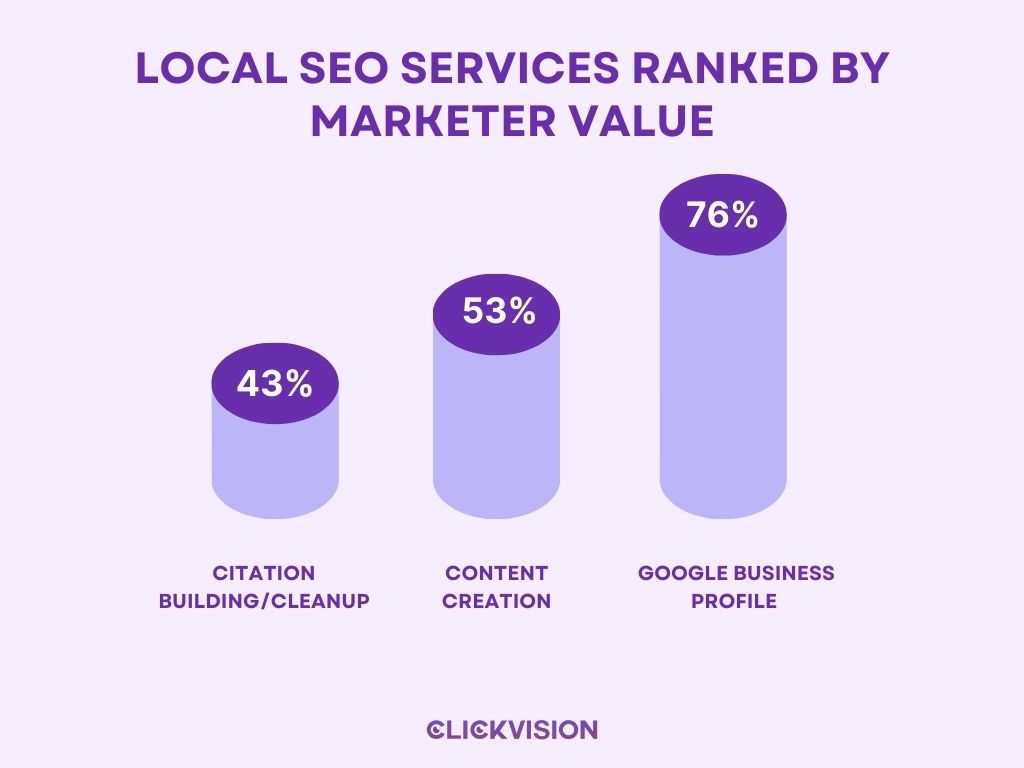
- According to marketers, the most valuable local SEO services are Google Business Profile management (76%), content creation (53%), and citation building/cleanup (43%). (Backlinko)
- The top five local SEO metrics marketers see as important are rankings in the Google Local Pack / Local Finder (52%), new leads/enquiries (42%), Google organic rankings (41%). (Backlinko)
- Local SEO leads have a 15% close rate. Local leads convert far higher than general marketing leads. (Krofile)
- 15% of leads from local SEO result in sales. (Synup)
- Local SEO industry is worth over $80 billion. Massive market validation of local SEO’s business impact and value. (Krofile)
- The average timeframe to see ROI positive results from Local SEO is 4.76 months. (Safaridigital)
I.2. Ranking factors
- Google may use 149 ranking factors for local searches. (Backlinko)
- On-page signals account for 36% of local search ranking influence, followed by link signals at 26% and behavioral signals at 9%. (SEOprofy)
- Factors like dedicated service pages, internal linking across the site, quality inbound links, and geographic keyword relevance scored highest among the elements that help improve local rankings. (SEOprofy)
- 36% of local SEO professionals consider on-page elements to be the top ranking factor for local organic search results. (SEOprofy)
- Reviews signals account for 15% of the local SEO pack rank. (99firms)
According to surveyed marketers, the most impactful ranking factors on Google’s local pack include the primary Google Business Profile category, keywords in the Google Business Profile title, the proximity of address to the point of search. (Brightlocal) - The most important factors for ranking in Google’s local pack are your primary Google Business Profile category, having relevant keywords in the profile title, and how close your business is to the searcher’s location. (SEOprofy)
- According to surveyed marketers, the most impactful ranking factors on Google’s local pack include the primary Google Business Profile category, keywords in the Google Business Profile title, the proximity of address to the point of search. (Whitespark)
- The most significant local organic ranking factors according to local marketers are a dedicated page for each service, internal linking across the entire website, and quality/authority of inbound links to the domain. (Whitespark)
| Local Pack Ranking Factor | Score |
| Primary Google Business Profile category | 193 |
| Keywords in Google Business Profile title | 181 |
| Proximity of address to the point of search | 176 |
| Physical address in the city of search | 170 |
| Removal of spam listings through spam fighting | 143 |
| High numerical Google ratings | 138 |
| Additional Google Business Profile categories | 134 |
| Quantity of native Google reviews | 128 |
| Verified Google Business Profile | 117 |
| Proximity of address to centroid | 114 |
| Keywords in Google Business Profile landing title | 114 |
| Completeness of Google Business Profile | 112 |
| Local Pack Ranking Factor | Score |
| Dedicated page for each service | 163 |
| Internal linking across the entire website | 149 |
| Quality/authority of inbound links to domain | 148 |
| Geographic keyword relevance of domain content | 146 |
| Keywords in Google Business Profile landing page title | 140 |
| Quality of inbound links to the domain from locally relevant domains | 137 |
| Topical keyword relevance across the entire website | 135 |
| Volume of quality content on service pages | 134 |
| Volume of quality content on the entire website | 132 |
| Keywords in the anchor text of inbound links to the domain | 128 |
| Diversity of inbound links to the domain | 127 |
| Mobile-friendly/responsive website | 125 |
I.3. ROI and economics
- 40% of local SEO campaigns achieve 500%+ or better ROI. Nearly half of local SEO investments return 5x their cost. (SEO AI) (Krofile)
- Average small business spends $501-$1000 monthly on local SEO. Accessible budget range for most small business owners. (Backlinko)
- Average hourly rate for local SEO services is $128. Professional local SEO is affordable compared to other marketing services. (Krofile)
J. Conversion & Purchase Behavior (Non-mobile-specific)
- Local searches lead to conversions 80% of the time. (seo.com)
- 28% of searches for something nearby lead to a purchase within a day. Nearly one in three local retail searches convert to sales. (SEO Profy) (Safari Digital) (Think with Google).
- 90% of local business searchers make a purchase within a week. (JS Interactive)
- 70% of consumers visit a store because of information they found online. (JS Interactive)
- Users conducting local searchers have high purchase intent, with almost a third of all searches with local intent resulting in a purchase. (Safaridigital)
Read More Related Statistics
Conclusion
The full picture painted by the local SEO statistics and data for 2026 leaves no room for comfortable denial. Local search is now the primary engine of customer acquisition, trust, and conversion — and the businesses that ignore it are voluntarily handing revenue to their competitors. Mobile-driven urgency, AI-powered discovery, Google Business Profile dominance, skyrocketing review influence, and the massive ROI of local SEO all point in the same direction: the market rewards visibility, credibility, and speed.
If you aren’t aggressively optimizing for local search, you’re not just missing opportunities — you’re actively losing customers who are searching, choosing, and buying somewhere else. The numbers make the decision simple: invest in local SEO or get left behind.