
If you want to understand where artificial intelligence is headed, watch what Google does with Gemini. In less than two years, this platform went from a stumbling chatbot reboot to the second-largest AI platform on earth – and the numbers behind that rise are staggering.
This guide pulls together every verified Google Gemini statistics worth knowing in 2026: user counts, revenue figures, enterprise adoption data, demographic breakdowns, API growth, and competitive benchmarks. Whether you’re a marketer trying to calibrate your AI strategy, a developer evaluating platforms, or an analyst tracking the space, you’ll find the most complete picture of Gemini’s scale and trajectory right here.
Key Takeaways: What the Gemini Statistics Tell Us
1. Gemini’s growth trajectory is unlike anything seen in consumer software. Going from 350M to 750M monthly active users in under a year – while simultaneously powering 2 billion AI Overview users – puts Gemini in genuinely rarified company.
2. The enterprise opportunity is enormous and early. 120,000 enterprises is a big number, but McKinsey’s data suggests most companies are still in early AI experimentation. The next wave of enterprise seat growth could dwarf the first.
3. Developer adoption is the long game. 85 billion API requests per month and 2.4 million active developers means an entire ecosystem of third-party applications is being built on Gemini infrastructure – creating compounding lock-in.
4. The demographic story favors continued growth. The 35–44 cohort being the fastest-growing segment, combined with mobile usage growing 210% year over year, points to Gemini moving from “early adopter” to “mainstream professional tool.”
5. Distribution is Gemini’s moat. The Apple Siri partnership, Samsung pre-installs, and integration across all 15 Google products with 500M+ users means Gemini has structural advantages that no competitor can buy or build quickly.
How Big Is Google Gemini Right Now?
Let’s start with the headline numbers, because they set the stage for everything else.
The Gemini app crossed 750 million monthly active users in Q4 2025, confirmed by Alphabet’s earnings report. That’s a 67% jump from 450 million at the start of the year – and when you include the separate population using Gemini-powered AI Overviews inside Google Search, total reach climbs to roughly 2 billion monthly users.
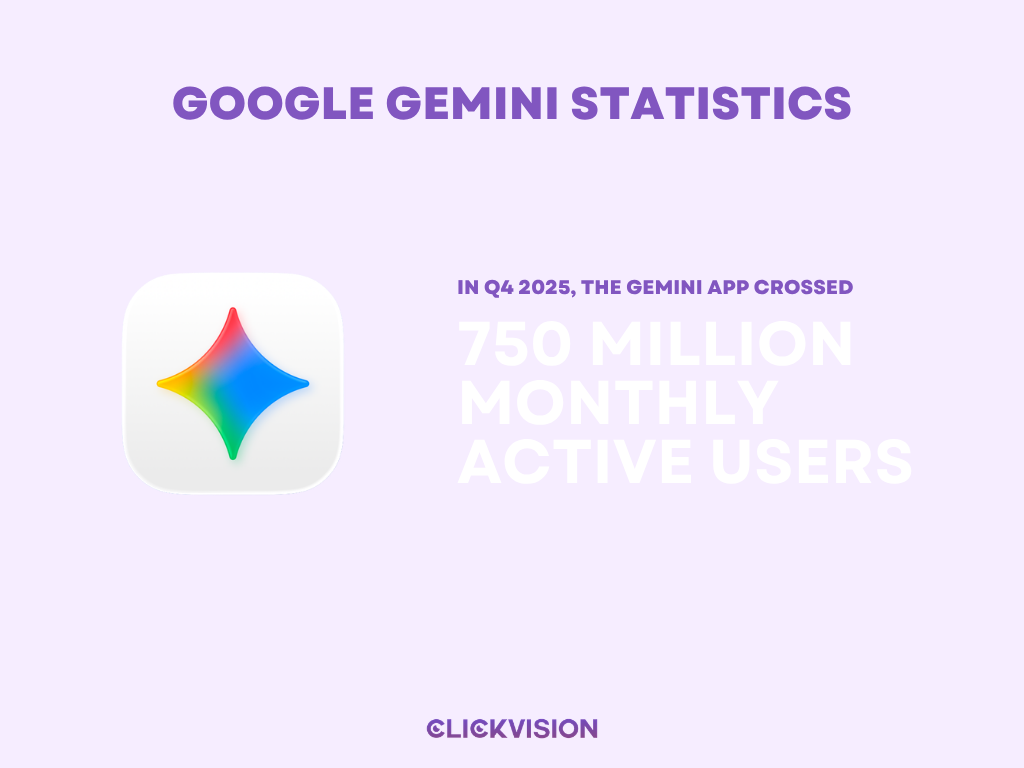
To put that second number in context: more people interact with Gemini through Google Search every month than use Instagram.
Daily engagement is equally strong. Early 2025 data put daily active users at 35 million for the standalone Gemini app, while AI Mode inside Google Search already had 75 million daily active users by late 2025 – a figure that signals habitual, not occasional, use.
750M
Gemini App MAUs
Q4 2025
~2B
Total Monthly Reach
Including AI Overviews
+67%
User Growth
450M → 750M in 2025
Google Gemini User Growth Statistics: The Full Timeline
The speed of Gemini’s growth is arguably more important than the absolute numbers. Here’s the verified MAU timeline, sourced from Alphabet earnings reports and third-party data:
| Period | Monthly Active Users |
|---|---|
| Full year 2024 average | ~90 million |
| Q1 2024 (Gemini launch year) | 142.6 million |
| Early 2025 / Q1 2025 | 350–450 million |
| May 2025 (Google I/O) | 400 million |
| Q3 2025 | 650 million |
| Q4 2025 / early 2026 | 750 million |
That’s roughly a 114% increase in a single calendar year – from around 350 million in April 2025 to 750 million by December. Similarweb independently estimated that Gemini’s web traffic grew 157% between April and September 2025 alone, making it the fastest-growing major generative AI platform during that window.
The growth isn’t slowing down either. Alphabet confirmed in its Q1 2026 earnings call that Gemini Enterprise paid monthly active users grew 40% quarter over quarter – a sign that paid adoption is accelerating even as the free tier matures.
Google Gemini App Downloads: Monthly Data
On the download side, the Gemini app has been installed over 430 million times since its May 2024 launch (Android, per AppMagic), with some estimates placing cumulative downloads across both Android and iOS closer to 500 million.
Full-year 2025 downloads reached 354 million, making it one of the most-downloaded apps in the world – not just in AI, but across all app categories. Appfigures ranked it among the top five most downloaded apps globally.
Here’s the monthly breakdown for 2024–2025:
| Month | New Downloads |
|---|---|
| July 2024 | 430,000 |
| August 2024 | 690,000 |
| September 2024 | ~728,000 |
| October 2024 | 330,618 |
| November 2024 | 1,404,821 |
| December 2024 (peak) | 1,612,763 |
| January 2025 | ~1,288,000 |
| February 2025 | 1,448,985 |
| March 2025 | 1,303,466 |
| December 2025 | 35.7 million |
| February 2026 | 27 million |
The December 2024 spike aligns with holiday device purchases and new Android activations. The December 2025 figure of 35.7 million represents an entirely different scale – driven by Gemini 3’s release and the platform’s deep integration into Android’s default experience.
Google Gemini Revenue Statistics
Gemini’s financial story is just beginning to come into focus. Google generated $1.2 billion from Gemini subscriptions in 2025, up from approximately $0.3 billion in 2024 – a 4x increase in one year.
But the real revenue story sits in Google Cloud. In Q1 2026, Google Cloud reported $20 billion in revenue, up 63% year over year – a figure Alphabet attributed directly to Gemini-powered enterprise demand. The cloud backlog stood at $460 billion, roughly double the prior quarter.
Subscription Pricing Tiers
| Plan | Monthly Price | AI Credits |
|---|---|---|
| Google AI Pro | $19.99 | 1,000 |
| Google AI Ultra | $249.99 | 25,000 |
The Ultra tier at $249.99/month targets power users and enterprises who need maximum context, priority model access, and advanced research features. Alphabet reported 350 million total paid subscriptions across Google properties as of Q1 2026, up 25 million from Q4 2025.
API Pricing (Developers)
| Model | Input (per 1M tokens) | Output (per 1M tokens) |
|---|---|---|
| Gemini 3 Pro | $2.00 | $12.00 |
| Gemini 3 Flash | $0.50 | $3.00 |
| Gemini 2.5 Pro | $1.25 | $10.00 |
| Gemini 2.5 Flash | $0.30 | $2.50 |
| Gemini 2.5 Flash-Lite | $0.10 | $0.40 |
One underreported financial metric: Google reduced Gemini’s serving costs by 78% in 2025, a dramatic efficiency gain that makes scaling the platform increasingly profitable as usage grows.
Google Gemini Market Share vs. Competitors
This is where the most important caveat in all of Gemini’s statistics lives: market share numbers vary dramatically depending on what’s being measured. Here’s a clean breakdown of the three main metrics in use.
Global GenAI Web Traffic Share (Similarweb, January 2026)
| Platform | Market Share |
|---|---|
| ChatGPT | 64.5% |
| Google Gemini | 21.5% |
| DeepSeek | 3.7% |
| Grok | 3.4% |
| Perplexity | 2.0% |
| Claude | 2.0% |
| Copilot | 1.1% |
Gemini’s 21.5% share is up from just 5.7% one year prior – meaning it nearly quadrupled its share of global AI traffic in 12 months. That’s the fastest market share expansion in the category’s history.
U.S. AI Chatbot Market (November 2025)
When the lens narrows to the United States specifically, the picture shifts slightly: ChatGPT held 59.7%, Microsoft Copilot 14.4%, and Gemini 13.5%. Copilot’s stronger U.S. position reflects its deep integration into Microsoft 365, which has enormous enterprise penetration in American businesses.
Monthly Visits Comparison (November 2025)
| Platform | Monthly Visits |
|---|---|
| ChatGPT | 5.84 billion |
| Gemini | ~1.35 billion |
| Perplexity | ~180 million |
| Claude | ~157 million |
ChatGPT’s visit lead is substantial, but Gemini’s gap is closing. More importantly, Gemini’s actual reach – counting AI Overviews in Search – puts its total user exposure far ahead of any standalone chatbot.
Google Gemini Usage Statistics: How People Actually Use It
The data on how users interact with Gemini is remarkably consistent across sources. Based on aggregated survey data:
40%
Research & information seeking:
the most common use case, reflecting Gemini’s search-native positioning
30%
Creative writing & content creation:
essays, scripts, brainstorming, coding
20%
Work/school productivity:
document summarization, homework help, workflow automation
10%
Entertainment:
casual chat, games, media discovery
A detail that signals the quality of use: since Gemini 3 launched, AI Mode queries in Google Search are 3x longer than traditional searches, and nearly 1 in 6 AI Mode queries use voice or images rather than text. These aren’t quick lookup searches – they’re complex, multimodal requests.
6m 59s
Average session duration
unusually long for a web app
4.21
Pages per visit
29.32% bounce rate
105m
Weekly enterprise usage
Workspace tools
Gemini’s Integration Across Google Products
- Google Meet uses Gemini to auto-summarize 78% of business meetings
- Gmail’s Smart Compose (Gemini-powered) has increased average typing speed by 34%
- In the first half of 2025, users edited over 1.4 billion Google Docs files using Gemini features
- Android Studio: Gemini assists in 23% of code editing sessions
- Google Cloud customers report 38% reduction in repetitive tasks
- Circle to Search, powered by Gemini, is available on 580 million Android devices
Google Gemini User Demographics
Who Uses Gemini?
Age distribution (Similarweb, consistent across multiple sources):
| Age Group | Share of Users |
|---|---|
| 18–24 | ~22% |
| 25–34 (largest group) | ~30% |
| 35–44 | ~20% |
| 45–54 | ~14% |
| 55–64 | ~9% |
| 65+ | ~5% |
The 25–34 cohort – older millennials and younger professionals – dominates Gemini’s user base, with over 52% of all users under 35. But the fastest-growing demographic is 35–44, suggesting Gemini is winning over mid-career professionals as AI tools become embedded in workplace workflows.
58%
Male
42%
Female
A Harvard Business School study cited in the research notes that women tend to adopt new AI tools more cautiously due to trust and ethical concerns – a gap that may narrow as Gemini becomes more mainstream.
Device breakdown: Desktop accounts for 71–74% of usage, reflecting Gemini’s dominant role as a work and productivity tool. Mobile’s 26–29% share is growing, though, fueled by app integrations and Gemini’s presence on billions of Android devices.
Where in the World Is Gemini Most Popular?
Gemini is available in 230–249 countries and territories, supports more than 40 languages (130+ for translation), and has achieved meaningful penetration in markets that other AI platforms largely ignore.
Top countries by traffic share (early 2026):
| Country | Traffic Share |
|---|---|
| United States | 14.99% |
| India | 6.46% |
| Japan | 6.38% |
| South Korea | 6.22% |
| Brazil | 5.30% |
India and Brazil combined account for 22% of Gemini’s new users in 2025 – and their growth is accelerating. South Korea saw the steepest month-over-month traffic increase in recent data. The Middle East grew 240% year over year, while Africa grew 180%, both driven by mobile-first adoption and Google’s Android ecosystem dominance.
The one relative weakness: Gemini underperforms versus ChatGPT in Western Europe and the UK – though that gap is narrowing as Google expands Workspace integrations and the Apple Siri partnership brings Gemini to hundreds of millions of iPhone users.
Google Gemini Enterprise Adoption Statistics
The enterprise story is where Gemini’s competitive moat becomes most visible – and where its financial trajectory makes the most sense.
As of Q4 2025:
- 120,000+ enterprises use Gemini
- 95% of the top 20 global SaaS companies have adopted it
- 80%+ of the top 100 SaaS companies use it in some capacity
- ~75% of Google Cloud customers now use Google’s AI products
- 8 million+ paid Gemini Enterprise seats across 2,800+ companies
- Gemini Enterprise handled 5 billion customer interactions in Q4 2025, up 65% year over year
The business impact data is equally compelling:
- Elanco (animal health company): $1.9M ROI from Vertex AI + Gemini implementation
- Radisson Hotel Group: 50% productivity gain in ad teams, 20%+ revenue increase from personalized campaigns
- Telecom Italia: 20% efficiency gain using a Gemini-powered voice agent for customer calls
- PODS: “World’s Smartest Billboard” campaign generated 6,000+ headlines targeting 299 neighborhoods in 29 hours
The healthcare and finance sectors saw the steepest enterprise adoption curves in 2025 – 3.4x growth in both verticals. More than 7,000 hospitals worldwide now use Gemini for patient intake and triage chatbots. In marketing, 42% of digital ads now include copy generated with Gemini assistance.
Google Gemini Developer & API Statistics
Gemini’s developer ecosystem is one of the most important – and underreported – dimensions of its growth.
API monthly requests:
35 billion
March 2025
85 billion
January 2026
(+142% growth in 10 months)
Active API developers:
1.1 million
March 2025
2.4 million
January 2026
(+118% year over year)
API processing speed:
- Q1 2026: 16 billion tokens per minute via direct API – up 60% quarter over quarter
Cumulative developer reach: 13 million developers have built with Google’s generative AI models overall, per Google’s own reporting.
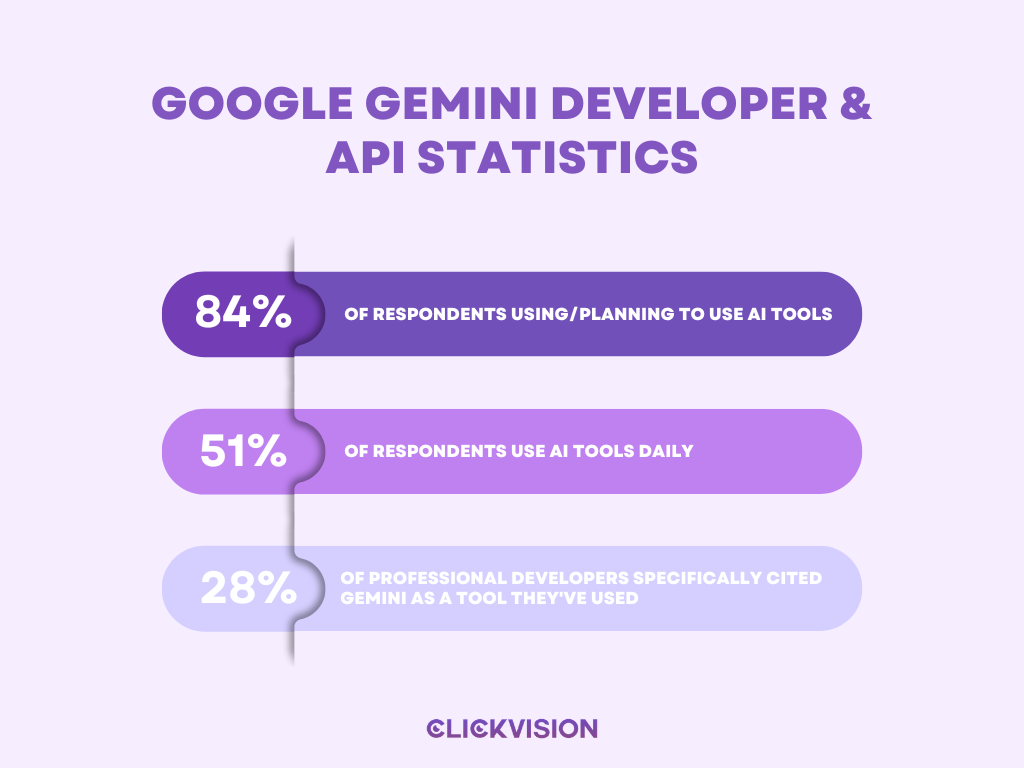
For context on developer sentiment: the Stack Overflow 2025 Developer Survey found 84% of respondents using or planning to use AI tools, 51% use them daily, and 28% of professional developers specifically cited Gemini as a tool they’ve used – a remarkable penetration figure for a platform that was barely known among developers just 18 months prior.
How Users Find Gemini: Traffic Source Breakdown
Gemini’s traffic profile tells an important story about brand strength.
| Channel | Traffic Share |
|---|---|
| Direct | ~75% |
| Organic Search | ~13–14% |
| Referrals | ~4% |
| Paid Search | ~3–4% |
| Social Media | ~1% |
| Display | ~0.3% |
| ~0.15% |
Three-quarters of visits come direct – meaning users type Gemini’s URL or open the app without being prompted by an ad or search result. That’s the behavior of an established daily habit, not a product people discover anew each session.
On social media specifically, YouTube drives 52–62% of all social referral traffic to Gemini, far ahead of Facebook (~10%), WhatsApp (~9%), and Twitter/X (~5%). This reflects a pattern familiar from other AI tools: YouTube tutorials and demo videos are the primary discovery channel for new users.
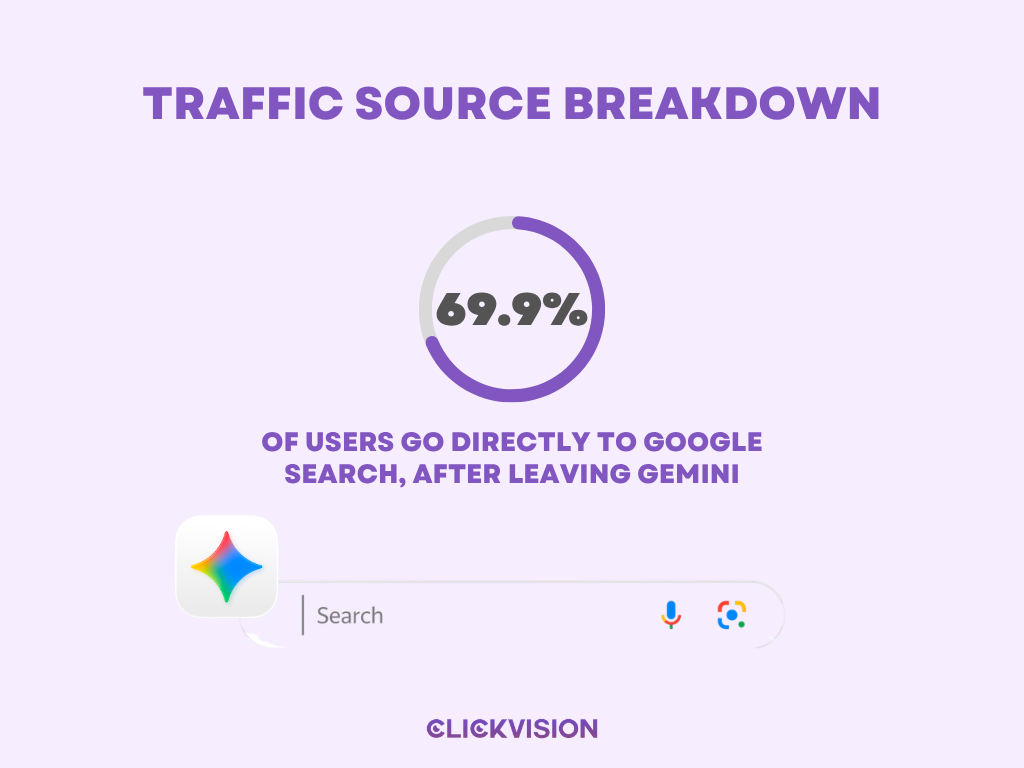
After leaving Gemini, 69.93% of users go directly to Google Search – reinforcing how deeply Gemini is embedded in a broader Google-centric information workflow.
The Broader AI Market Context
Gemini’s growth doesn’t happen in a vacuum. The macro environment is accelerating everything.
Gartner forecasts global AI spending will reach $2.52 trillion in the end of 2026, up 44% year over year, with generative AI model spending specifically growing 80.8%. McKinsey’s 2025 State of AI report found 78% of organizations now use AI in at least one business function – but critically, only 1% of executives describe their GenAI deployments as “mature.” That gap between current adoption and maturity represents the growth runway still ahead.
Gemini is positioned to capture a large share of that runway. Unlike ChatGPT, which requires users to visit a standalone destination, Gemini is embedded directly into the products billions of people already use every day: Google Search, Gmail, Docs, Chrome, Android, and now Apple’s Siri. That distribution advantage – what analysts have called an “ecosystem moat” – is difficult to replicate.
Found this data useful? Share it with your team or link to it as a reference – we update this guide as new Google Gemini statistics are released. You might also want to explore our related resources on AI marketing trends and enterprise AI adoption strategies.