
Threads marketing statistics tell a story of two speeds. Brands jumped in fast during 2025, and more than half were posting by year’s end. B2B teams moved slower, even though many of their own marketers ranked Threads as their best organic channel. That gap between belief and action says a lot about where the platform stands today.
This guide breaks down what’s driving that shift. You’ll see how Threads engagement compares to X and Bluesky. We’ll also cover the best formats and posting times, plus Meta’s ad rollout and current CPM costs. By the end, you’ll know exactly where Threads fits into a real marketing plan.
Threads Adoption Among Marketing Teams
Brand adoption on Threads moved fast through 2025 and shows no signs of slowing. The numbers below come from two separate survey waves run months apart, which is worth keeping in mind since the figures shift slightly depending on when each survey closed.
- 57% of brands were already posting on Threads as of Sprout Social’s Q1 2025 Marketer Pulse Survey, and another 23% planned to join. (Sprout Social)
- A separate report, the 2025 Sprout Social Index, put current adoption at 53%, with the same 23% still planning to join. (MarTech)
- 64% of B2C brands post on Threads, compared with just 19% of B2B brands. (Sprout Social)
- 31% of B2B marketers plan to build a dedicated Threads presence. (Sprout Social)
- 85% of B2B marketers ranked Threads as the platform with the best organic ROI in 2026. (Sami Haraketi)
- Only 10% of brands said they had no plans to join Threads or Bluesky at all. (MarTech)
- 36% of marketers said their audience is spending more time on emerging platforms like Threads, Bluesky, Lemon8, and Mastodon. (inBeat, MarTech)
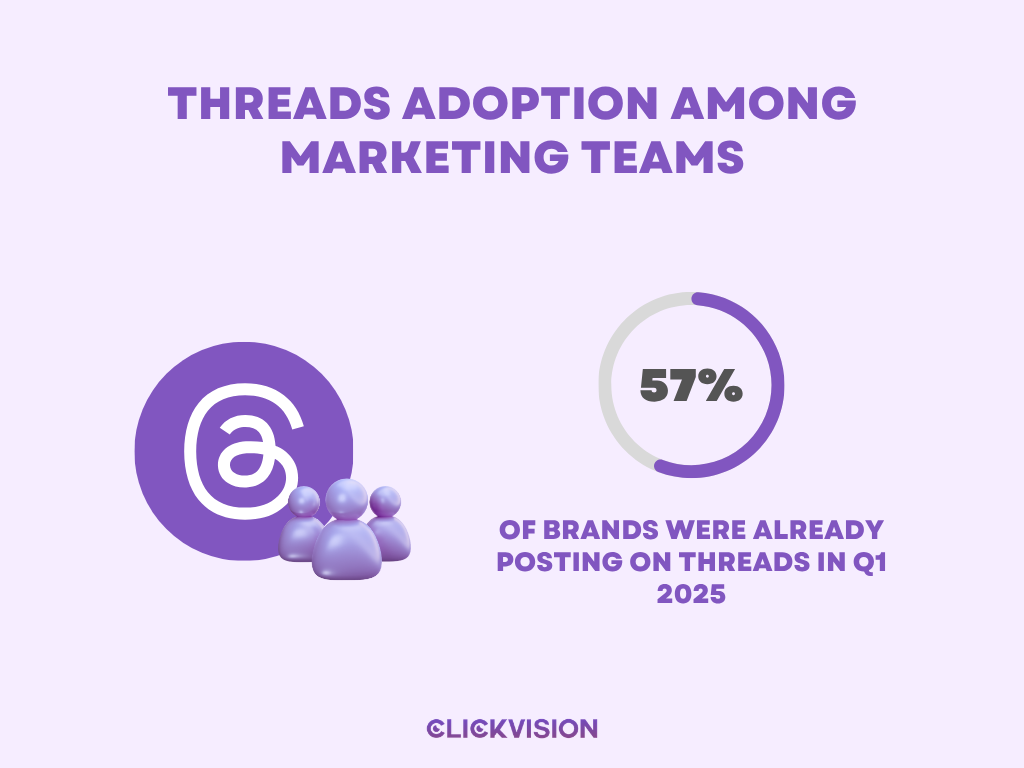
The gap worth watching sits between B2C and B2B. Only 19% of B2B brands are posting today, yet 85% of B2B marketers already rate Threads as their best organic channel. That’s a lag between belief and action, not a lag in results, and it points to Threads being underused by B2B teams relative to what they already think it can do for them.
Creator Partnerships and Influencer Reach
Brand adoption is only half of the growth story on Threads. Creators are building the other half, and marketers are starting to fund it directly instead of treating it as a side effect of organic reach.
- 59% of marketers plan to partner with creators on Threads specifically. (Sami Haraketi, Outfy)
- 92% of marketers say influencer content on Threads reaches further than posts from branded accounts. (Outfy)
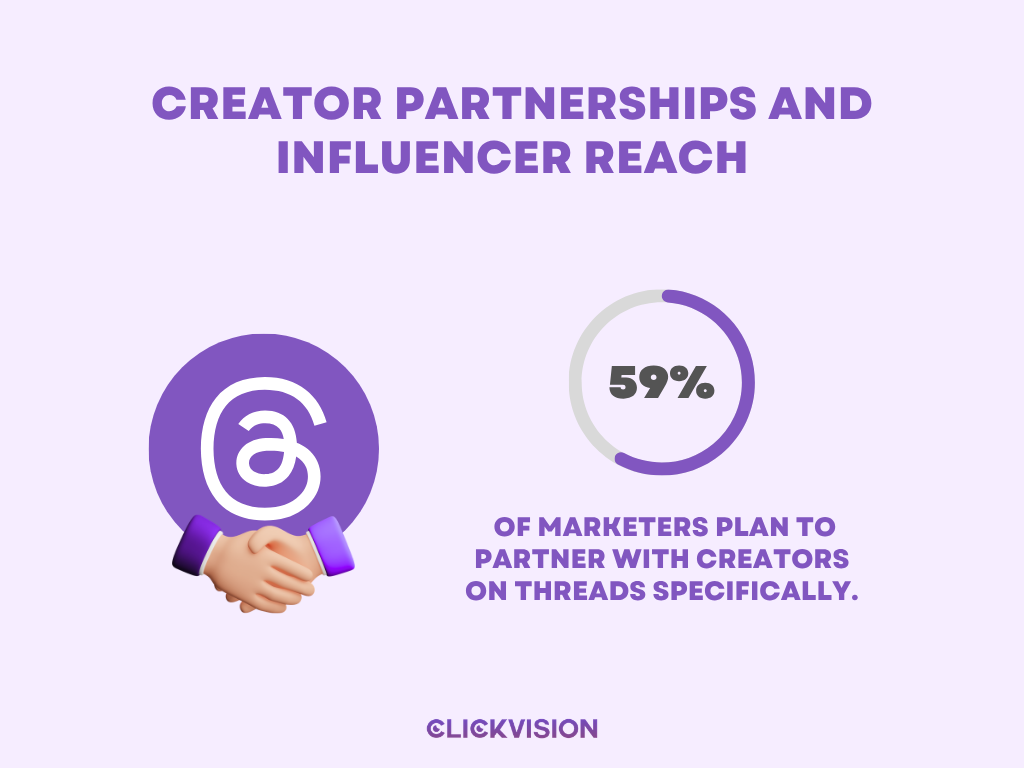
With 92% of marketers conceding that creator content outperforms their own branded posts, the practical takeaway is that a creator partnership budget line is no longer optional for teams chasing reach on Threads.
Engagement Rates: Threads vs. X vs. Bluesky
Engagement rate is the number that decides whether organic posting on Threads is worth the time investment at all, separate from any paid spend. Every source below disagrees slightly on the exact figure, but all of them agree on the direction: Threads consistently beats X on engagement rate, even while X still wins on sheer volume.
| Platform | Median Engagement Rate | Avg. Engagements per Post | Source |
| Threads | 6.25% | 58 | inBeat |
| X | 3.6% | 328 | inBeat |
| Bluesky | Not reported | 21 | inBeat |
- Threads’ median engagement rate ranges from 3.8% to 4.5%. (Sprout Social)
- Threads’ median engagement rate of 6.25% beats X’s 3.6%, a 73.6% gap in Threads’ favor. (inBeat)
- Creator content on Threads gets 4.51% engagement, compared with 2.31% on X. (Sami Haraketi)
- X still generates more raw engagement per post: an average of 328, against 58 on Threads and 21 on Bluesky. (inBeat)
- A study of 1.7 million posts found a median of 5 engagements per post, up from an average of 4 in 2024. (inBeat, Sami Haraketi)
- 30% of Threads users engage with brand content at least once a week. (Sprout Social)
- 3% of users say they’d use Threads as a dedicated channel to contact brands during the holiday season. (Sprout Social)
Rate and volume answer different questions. A higher engagement rate means a Threads post is more likely to get a reaction from whoever sees it. Higher raw volume on X means more total people are seeing and reacting to a post overall. Brands chasing depth of interaction lean toward Threads; brands chasing total reach still have reasons to keep posting on X.
Photo Posts Outperform Video, Links, and Text on Threads
Format is one of the few variables a brand controls directly, unlike posting frequency limits or algorithm changes, which makes this data more actionable than most of the numbers above.
- Photos generate 0.6% more median engagement than video posts. (inBeat)
- Photos generate 37% more engagement than posts containing links. (inBeat)
- Photos generate 60% more engagement than text-only posts. (inBeat)
Wednesday Morning Is the Best Time to Post on Threads
- Wednesday at 7 a.m. is the strongest median engagement window on Threads. (inBeat)
- Weekday mornings between 7 a.m. and 9 a.m. perform consistently well overall. (inBeat)
Scheduling around this window costs nothing beyond adjusting a publishing calendar, which makes it one of the easier fixes on this list to act on immediately.
Replying and Asking Questions Raise Engagement
Two habits stand out because neither one requires a content budget or a format change, just a shift in how a team already posts.
- Replying to comments on your own posts increases engagement by 42%, per a Buffer study. (Sami Haraketi)
- Posts phrased as questions outperform posts phrased as statements by 3 to 5 times. (iMark Infotech)
Threads Advertising Rollout Timeline, January 2025 to Q2 2026
Meta rolled out Threads advertising in stages instead of launching everywhere at once. That caution makes more sense given what happened to X’s ad business after Elon Musk’s takeover, and it shows up clearly once the milestones are laid out in order.
| Milestone | Date | Source |
| Limited ad test with select advertisers | January 2025 | MarTech |
| Ads opened to all US advertisers | Late April 2025 | MarTech |
| Global ad launch; ad-related brand pauses reported | November 2025 | Sami Haraketi |
| Ad inventory opened to all global advertisers | Early 2026 | Sprout Social |
| Full advertising rollout expected | Q2 2026 | Sprout Social |
- When Meta introduced advertising on Threads, it said three out of four people on the platform already followed at least one business account. (MarTech)
- The global ad opening runs through Meta Ads Manager with three initial formats: single image, carousel, and video. (iMark Infotech)
A three-in-four following rate for business accounts is a strong starting audience for any brand entering paid Threads campaigns for the first time.
Threads Cost Per Thousand Impressions
CPM stands for cost per thousand impressions, the standard price benchmark for comparing ad costs across platforms. It’s the number that decides whether a Threads campaign is cheaper to run than the same campaign on Instagram or X.
| Platform | Estimated CPM | Source |
| Threads | $5-$10 | Social Shepherd |
| X | ~$10 | Social Shepherd |
| 30-40% higher than Threads | iMark Infotech |
- Threads CPM runs an estimated $5 to $10, tied to Meta’s ad ecosystem integration. (Social Shepherd, inBeat)
- Threads ads generate 2x higher engagement than comparable Instagram placements. (iMark Infotech)
- Threads creator rates run 50 to 70% cheaper than equal-sized Instagram creators for comparable sponsored content. (iMark Infotech)
Cheaper impressions paired with higher engagement than Instagram is the combination that makes Threads worth testing with real ad budget rather than treating it as an organic-only channel.
Meta Ad Objectives and Conversion Benchmarks on Threads
- All 6 Meta ad objectives work with Threads placements: Awareness, Traffic, Engagement, Leads, App Promotion, and Sales. (Outfy)
- The average conversion rate for Meta ads across all industries sits at 9.21%, a benchmark that applies to Threads since it runs on the same ad infrastructure. (Outfy)
Sharing infrastructure with the rest of Meta’s ad platform means a team already running Instagram or Facebook campaigns can extend existing creative and targeting to Threads without rebuilding a campaign from scratch.
Ad Rollout Issues After the November 2025 Global Launch
The advertising story on Threads isn’t uniformly positive. The global launch created real friction for early advertisers, and the data below shows exactly where it showed up.
- 1 in 6 of the first partner brands paused their Threads ad campaigns after Meta’s global launch in November 2025. (Sami Haraketi)
- Reasons cited include ad loading delays, high accidental click rates, and brand safety concerns. (Sami Haraketi)
- Average daily time spent on Threads dropped from 18 minutes to 12 minutes following the rollout. (Sami Haraketi)
- Recommendation algorithm upgrades drove a 35% increase in time spent on Threads over a prior six-month period, offsetting some of that friction. (inBeat)
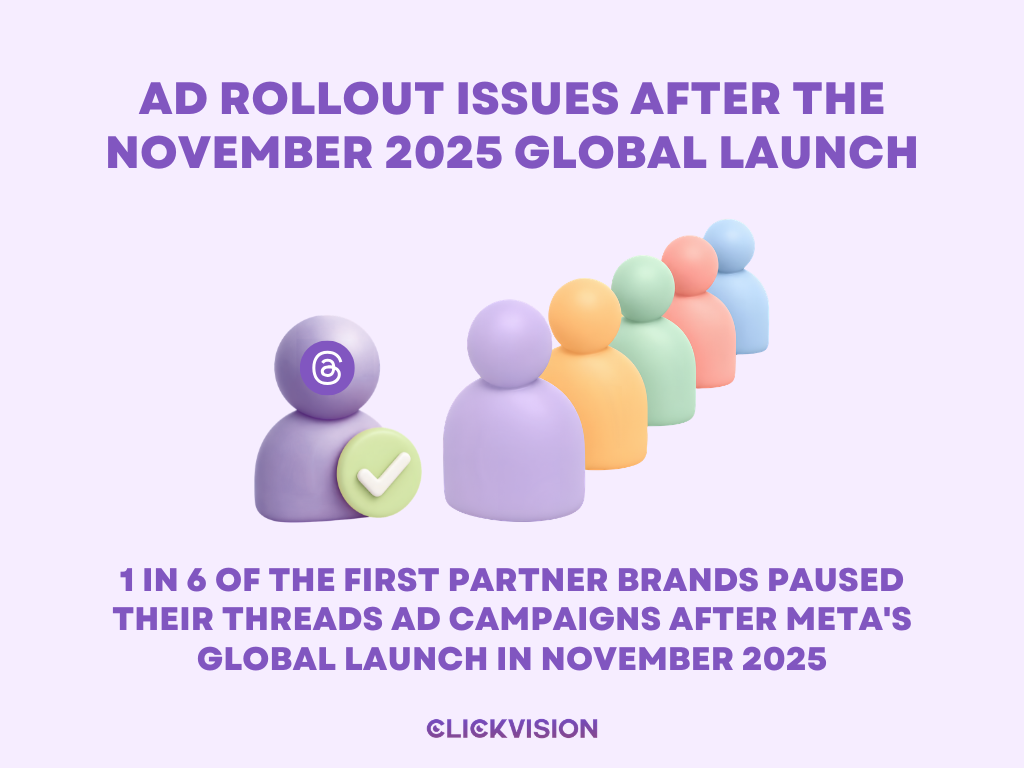
The algorithm gains and the ad-related time drop happened close together, which suggests Meta was fixing usage problems on one side of the platform while advertising problems were still working themselves out on the other.
Conclusion
Threads marketing statistics make one thing clear: this platform rewards brands that show up consistently, not just the ones that show up first. Adoption grew steadily through 2025, engagement stayed strong, and advertising matured enough to become a real budget option. None of that happened by accident. It happened because Threads found a rhythm that favors genuine interaction over noise.
Whether a brand is still testing the waters or already running paid campaigns, the direction is the same. Reply to comments, post at the right times, and treat creators as partners, not afterthoughts. With the right approach, Threads stops being a side channel and starts pulling real weight in a marketing plan.