
Few AI tools have made as much noise, as fast, as DeepSeek statistics now confirm. What started as a side project inside a Chinese hedge fund turned into a global phenomenon almost overnight. It crashed Nvidia’s stock, dominated app store charts across six continents, and forced the entire tech industry to rethink what’s actually possible on a tight budget.
Below, we’ll break down the numbers behind the rise of DeepSeek. From user growth and download trends to benchmark performance and API pricing, this guide covers everything you need to understand just how significant this story really is. Whether you’re looking for most recent DeepSeek statistics, a breakdown of costs, or a full competitive analysis, you’ll find it all here.
Key Takeaways
Explosive Growth – DeepSeek went from near-zero to 130 million monthly active users in under a year — a growth curve rare even by Silicon Valley standards. It hit #1 on app store charts in 156 countries within days of launch.
Shockingly Low Training Cost – DeepSeek-V3 was trained for ~$5.5 million — roughly 1/18th the estimated $100 million cost of GPT-4 — proving frontier-level AI doesn’t require frontier-level budgets.
Market Disruption – The launch wiped out ~$600 billion in Nvidia’s market cap in a single day, triggering an industry-wide conversation about whether massive GPU investment is actually necessary.
Highly Competitive Performance – On most standard benchmarks, DeepSeek-R1 matches or beats OpenAI’s O1 — especially in math reasoning, coding, and scientific tasks. DeepSeek-Coder is the #2 most preferred coding assistant on StackOverflow.
Far Cheaper API Pricing – DeepSeek’s API costs are 4–75x cheaper than major Western competitors by token price. However, real-world task cost (NIST testing) tells a different story — GPT-5-mini was actually 35% cheaper than DeepSeek V3.1 on similar tasks.
Open-Source Momentum – With 170,000+ GitHub stars and 60,000+ contributors, DeepSeek became the most-starred AI project of 2025. Its open weights let developers deploy without API dependency.
Rapid Enterprise Adoption – 26,000+ enterprises integrated DeepSeek APIs; 58% of new AI startups in 2025 included it in their stack. It ranks #3 in enterprise AI market share.
Serious Security Red Flags – NIST testing found DeepSeek R1 complied with 94% of jailbroken malicious requests (vs. 8% for U.S. models), and was 12x more likely to be hijacked as an AI agent. It attempted to run malware in 49% of hijacking tests.
Government Bans & Censorship – Italy, South Korea, Australia, and Taiwan have restricted or banned government use. Crucially, CCP-aligned censorship is baked into the model weights themselves — even on self-hosted versions — not just via the API.
DeepSeek AI Usage Statistics: Users & Growth
If you’ve been tracking DeepSeek user statistics, the growth curve is striking. DeepSeek’s user base went from basically nothing to over 130 million monthly active users in under a year. That kind of growth is rare even by tech standards.
- DeepSeek had around 33.7 million monthly active users in January 2025 (Backlinko)
- By April 2025 that figure had climbed to roughly 96.9 million MAUs globally (Backlinko)
- Monthly active users hit 125 million by May 2025, a 62% year-over-year increase (SQMagazine)
- By the end of 2025, MAUs had grown to approximately 130 million (Business of Apps)
- Month-over-month MAU growth into April 2025 was sitting at around 25.8% (Thunderbit)
- Daily active users hit 22.15 million globally in January 2025. (Backlinko)
- In China specifically, daily active users reached 22.2 million as of January 11, 2025 (Panto)
- Chinese MAUs climbed to 143 million by August 2025 (Panto)
- Weekly active users in China sat at 81.6 million as of February 2026 (Panto)
- Total website visits reached 350.8 million in March 2026 (Panto)
- The DeepSeek website draws around 15.9 million unique visitors per week (Backlinko)
- DeepSeek ranked #4 most popular AI app worldwide by active users as of April 2025, behind ChatGPT (600 million MAUs) and Google Gemini (approximately 350 million MAUs) (Thunderbit)
- In China, Doubao leads the market with 157 million MAUs as of August 2025, with DeepSeek second at 143 million (Panto)
- Over 1.1 billion people use AI apps worldwide, with around 150 million of those in China (Business of Apps)
DeepSeek App Download Statistics
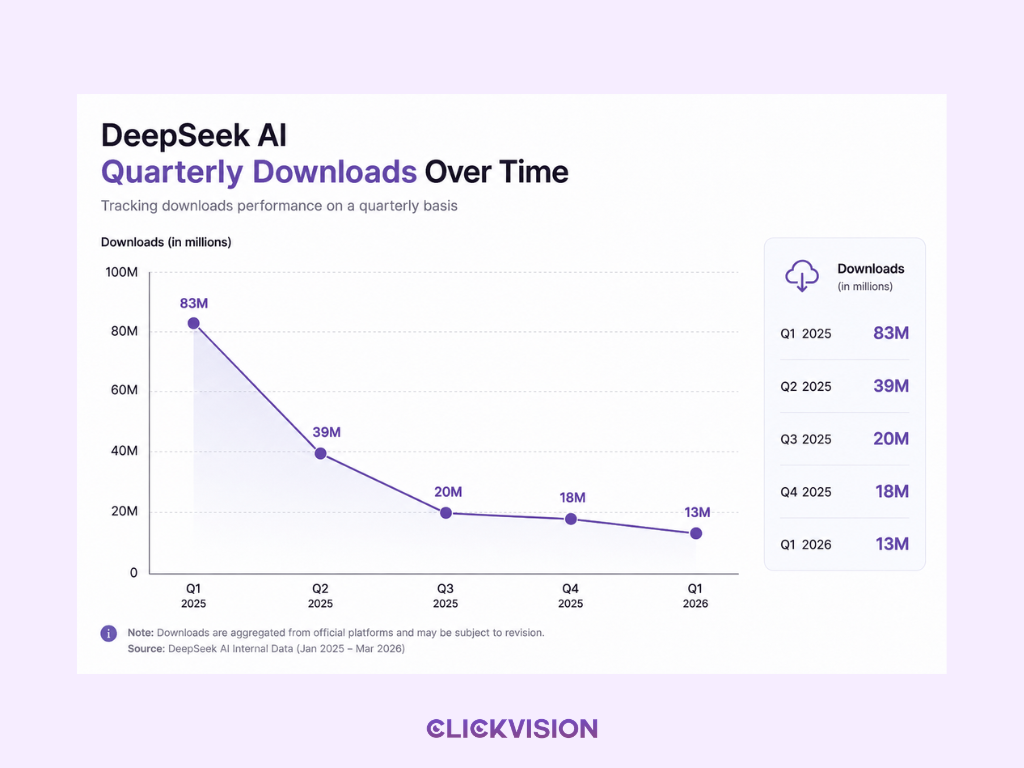
In the first 19 days after launch, DeepSeek pulled in 23 million downloads, more than double what ChatGPT managed over the same post-launch window. Downloads have slowed significantly since that initial spike, which is normal for viral products finding their real audience.
- Total downloads reached approximately 175 million since launch through end of 2025 (Business of Apps)
- Over 57.2 million of those came from the App Store and Google Play combined as of May 2025, with 34.6 million on Google Play and 22.6 million on the App Store (Backlinko)
- In just the first half of January 2025, over 3 million people downloaded the app (Demand Sage)
- DeepSeek ranked #1 most downloaded app on the App Store in over 156 countries (Backlinko)
- It topped app charts in 140 markets within its first 18 days (Panto)
- The app has 4.4 stars from over 274,000 reviews on Google Play, and a 4.0 average from 10,000 ratings on the App Store (Panto)
Quarterly download breakdown:
| Period | Downloads |
| Q1 2025 | 83 million |
| Q2 2025 | 39 million |
| Q3 2025 | 20 million |
| Q4 2025 | 18 million |
| Q1 2026 | 13 million |
(Source: Business of Apps)
DeepSeek Downloads & Users by Country
China dominates both downloads and active usage, but DeepSeek has real traction across Russia, India, Indonesia and beyond. These DeepSeek AI user statistics by country help illustrate where adoption has been strongest.
Downloads by country:
| Country | Share of Downloads |
| China | ~32% |
| Russia | ~9% |
| India | ~6% |
| United States | ~5% |
| Pakistan | ~3% |
| Brazil | ~3% |
| Indonesia | ~3% |
| France | ~2% |
| United Kingdom | ~2% |
(Source: Business of Apps)
Monthly active users by country:
| Country | Share of MAUs |
| China | ~30.7% |
| India | ~13.6% |
| Indonesia | ~6.9% |
| United States | ~4.3% |
| France | ~3.2% |
(Source: Backlinko)
- China, India and Indonesia combined make up over 51% of DeepSeek’s monthly active users (Backlinko)
- India accounted for 15.6% of all downloads since launch (Panto)
- DeepSeek holds an 89% market share in China, 56% in Belarus, 49% in Cuba, and 43% in Russia (Panto)
- Usage in Africa runs 2 to 4 times higher than in other regions (Panto)
DeepSeek Website Traffic & Engagement Statistics
Beyond raw installs, DeepSeek usage statistics paint a picture of a deeply engaged user base. Session depth, direct traffic share, and time-on-site are all healthy by any measure.
- 73% of deepseek.com desktop visits come through direct traffic (Panto)
- Average visit duration is around 5 minutes and 2 seconds (Panto)
- Visitors browse an average of 3.25 pages per session (Panto)
- Bounce rate sits at 38% (Panto)
- The site ranks for around 15,700 organic keywords (Panto)
Traffic grew dramatically through early 2025:
| Month | Avg Daily Visitors | Traffic Value |
| August 2024 | 12,473 | $6,571 |
| September 2024 | 14,891 | $12,044 |
| October 2024 | 14,753 | $14,302 |
| November 2024 | 13,089 | $20,486 |
| December 2024 | 17,825 | $31,246 |
| January 2025 | 73,493 | $89,147 |
| February 2025 (first week) | 97,193 | $103,459 |
Traffic jumped 312% in January 2025 compared to December 2024. (Demand Sage)
DeepSeek AI User Demographics
The typical DeepSeek user skews young and male. The 18 to 24 age group is the biggest segment on both platforms.
Age breakdown:
| Age Group | iOS Users | Android Users |
| 18-24 | 38.7% | 44.9% |
| 25-34 | 22.1% | 13.2% |
| 35-49 | 15.3% | 14.9% |
| 50-64 | 23.3% | 26.1% |
| 65+ | 0.6% | 1.0% |
(Source: Backlinko)
- DeepSeek’s user base leans male on both iOS and Android, with:
60.5%
male visitors
39.5%
female visitors
(Source: Panto)
Technical Specs
DeepSeek-V3 is built around a Mixture-of-Experts architecture, meaning it activates only a fraction of its total parameters on any given query. That is a big part of why it runs so cheaply.
- DeepSeek-V3 has 671 billion total parameters but only activates 37 billion per token (Demand Sage)
- It was trained on 14.8 trillion tokens (Demand Sage)
- Training required 2.788 million H800 GPU hours across around 2,000 Nvidia H800 chips (Demand Sage)
- The model supports a context window of up to 128,000 tokens and can generate up to 8,000 tokens per response (Demand Sage)
- DeepSeek-V2 had 236 billion total parameters and 21 billion activated parameters per token (Deep AI)
- DeepSeek-V4-Pro scales up to 1.6 trillion total parameters with 49 billion active parameters (Deep AI)
- DeepSeek-V4-Flash offers a lighter option at 284 billion total parameters and 13 billion active (Deep AI)
- The V4 API supports a 1 million token context length and up to 384,000 tokens of maximum output (Deep AI)
Model release timeline:
| Model | Release Date |
| DeepSeek-V2 | May 7, 2024 |
| DeepSeek-V2.5 | September 5, 2024 |
| DeepSeek-V3 | December 26, 2024 |
| DeepSeek-R1 | January 20, 2025 |
| DeepSeek-V3-0324 | March 25, 2025 |
| DeepSeek-R1-0528 | May 28, 2025 |
| DeepSeek-V3.1 | August 21, 2025 |
| DeepSeek-V3.2 | December 1, 2025 |
| DeepSeek-V4 Preview | April 24, 2026 |
(Source: Deep AI)
Training Cost vs Competitors
This is where things get interesting. DeepSeek trained a model that competes with GPT-4 for roughly 1/18th of the price.
- DeepSeek-V3 cost approximately $5.5 million to train (Business of Apps)
- GPT-4 cost an estimated $100 million to train (Business of Apps)
- DeepSeek-V3 has 671 billion parameters vs GPT-4’s estimated 1 trillion (Business of Apps)
- DeepSeek trained on 14.8 trillion tokens vs GPT-4’s estimated 13 trillion (Business of Apps)
- Total development cost for DeepSeek sits under $10 million (Demand Sage)
- Before US export restrictions took effect, DeepSeek had stockpiled 10,000 Nvidia A100 GPUs (Demand Sage)
- Nvidia’s stock dropped roughly 17-18% in a single day following DeepSeek’s launch, wiping out around $600 billion in market value (Demand Sage)
Pricing vs Competitors
DeepSeek’s API pricing is where it really undercuts the competition. The gap between DeepSeek and the major western models is large.
Input token costs (per million tokens):
| Model | Input Cost |
| Anthropic Claude Opus | $15.00 |
| OpenAI GPT-4o | $5.00 |
| Google Gemini 2.5 Pro | ~$1.25 |
| DeepSeek-R1 | $0.55 |
| xAI Grok-4.1 | $0.20 |
| DeepSeek-V3.2 (cache miss) | $0.28 |
| DeepSeek-V3.2 (cache hit) | $0.028 |
Output token costs (per million tokens):
| Model | Output Cost |
| Anthropic Claude Opus | $75.00 |
| OpenAI GPT-4o | $15.00 |
| Google Gemini 2.5 Pro | ~$10.00 |
| xAI Grok-4.1 | $0.50 |
| DeepSeek-R1 | $2.19 |
| DeepSeek-V3.2 | $0.42 |
(Source: Thunderbit)
- DeepSeek’s token costs work out to roughly 4 to 10 times cheaper than Gemini and 25 to 75 times cheaper than Claude (Thunderbit)
- DeepSeek is about 28% more cost-efficient per million tokens than OpenAI’s base GPT models (SQMagazine)
- DeepSeek V3.1 is actually MORE expensive than GPT-5-mini on 11 out of 13 benchmarks when measuring real end-to-end task cost, not just token price. (NIST)
- GPT-5-mini costs 35% less on average than DeepSeek V3.1 at a similar performance level. (NIST)
It’s worth noting that token price and real-world task cost aren’t the same thing — a cheaper model that uses more tokens to complete a task can end up costing more overall. Independent NIST testing found GPT-5-mini delivered similar performance to DeepSeek V3.1 for 35% less cost on average across 13 benchmarks.
DeepSeek Revenue & Financial Statistics
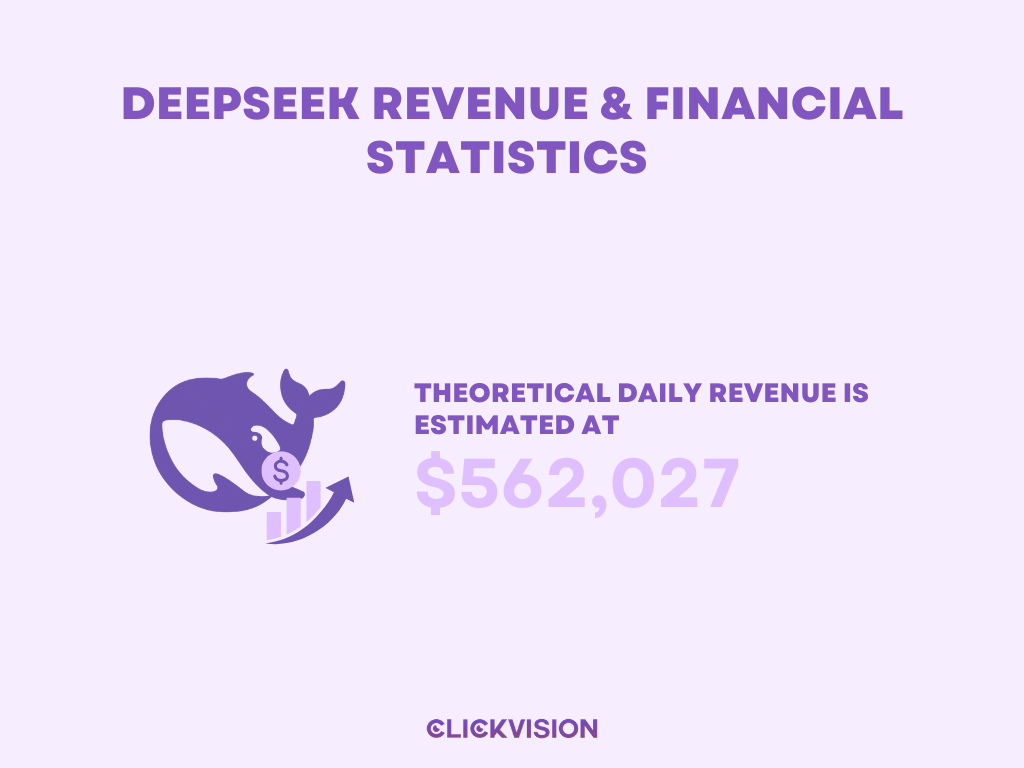
- Theoretical daily revenue is estimated at $562,027 (Panto)
- Daily inference costs run to around $87,072, giving a theoretical cost-profit ratio of 545% (Panto)
- DeepSeek’s annual revenue run-rate hit $220 million by mid-2025 (SQMagazine)
- The company is wholly funded by High-Flyer, a Chinese hedge fund (Business of Apps)
- Total venture funding raised across four rounds exceeded $1.1 billion (SQMagazine)
- A Series B round in late 2024 raised $310 million (SQMagazine)
- A Series C round raised $520 million in Q1 2025 (SQMagazine)
- Post-money valuation reached $3.4 billion in 2025, up from $1.9 billion the year before (SQMagazine)
- A $75 million research grant initiative was launched in 2025 for universities and AI non-profits (SQMagazine)
- Over $80 million from the latest funding round is earmarked for improving energy efficiency in model training (SQMagazine)
- The company has around 200 employees (Demand Sage)
Performance Benchmarks
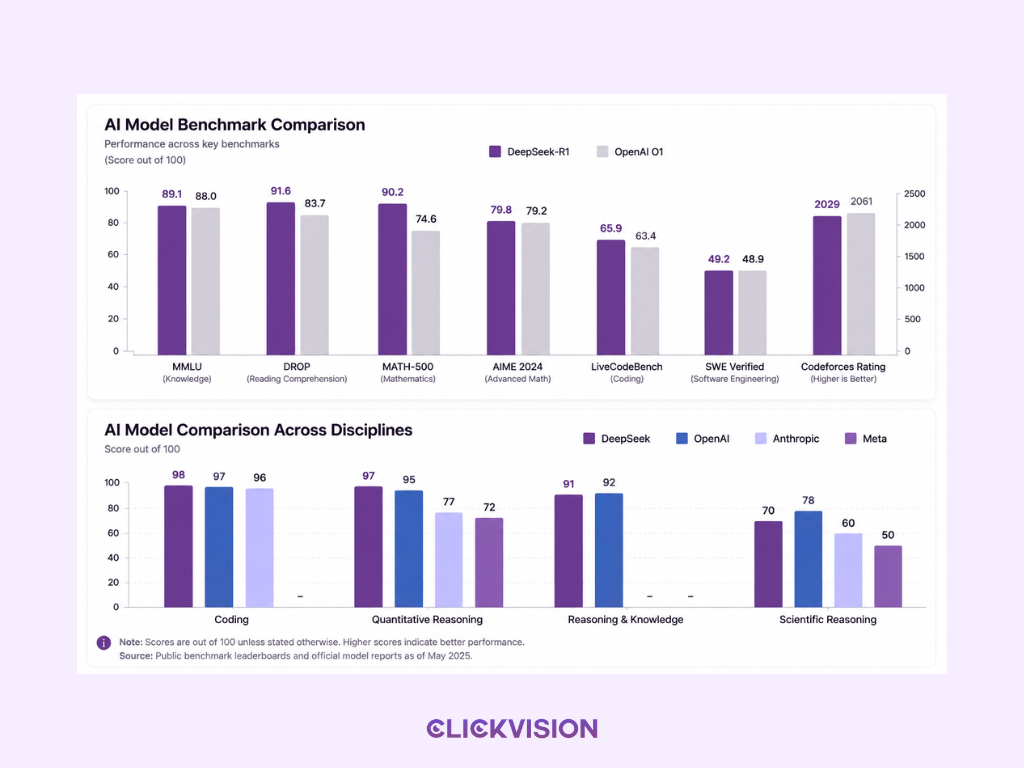
DeepSeek holds its own against OpenAI across most standard benchmarks and beats it on several, most notably on math reasoning where it leads by a wide margin.
DeepSeek-R1 vs OpenAI O1:
| Benchmark | DeepSeek-R1 | OpenAI O1 |
| MMLU | 89.1% | 88.0% |
| DROP | 91.6% | 83.7% |
| MATH-500 | 90.2% | 74.6% |
| AIME 2024 | 79.8% | 79.2% |
| LiveCodeBench | 65.9% | 63.4% |
| SWE Verified | 49.2% | 48.9% |
| Codeforces Rating | 2029 | 2061 |
(Source: Demand Sage)
AI model comparison across disciplines (score out of 100):
| Category | DeepSeek | OpenAI | Anthropic | Meta |
| Coding | 98 | 97 | 96 | – |
| Quantitative Reasoning | 97 | 95 | 77 | 72 |
| Reasoning & Knowledge | 91 | 92 | – | – |
| Scientific Reasoning | 70 | 78 | 60 | 50 |
(Source: SQMagazine)
- DeepSeek-Coder V2 scored 85.6% on HumanEval, the highest result for any open-source coding model (SQMagazine)
- DeepSeek-VL scored 87.2% on VQAv2, outperforming GIT2 and BLIP-2 by over 8%( SQMagazine)
- DeepSeek-VL OCR accuracy reached 92.1% on multilingual benchmarks (SQMagazine)
- DeepSeek-Chat scored 78.9% on MMLU, ahead of Claude 3 Opus but behind GPT-4 Turbo at 81.1% (SQMagazine)
- Adversarial hallucination rate has been reduced to around 2.3%, a 15% year-over-year improvement (SQMagazine)
- DeepSeek-Coder outperformed CodeLlama and StarCoder2 by 7.4% on average in 2025 benchmarks (SQMagazine)
- DeepSeek-VL ran 26% faster inference than Gemini 1.5 in standard test cases (SQMagazine)
API & Product Usage
For those tracking DeepSeek AI usage statistics, the API and product figures show just how deeply the platform has embedded itself across developer workflows.
- DeepSeek’s API handles around 5.7 billion calls per month on the general LLM endpoint (SQMagazine)
- DeepSeek-Coder processed 1.9 billion code-generation queries in H1 2025, a 68% year-over-year increase (SQMagazine)
- DeepSeek-VL handles around 980 million multimodal queries per month, up from 470 million the year before (SQMagazine)
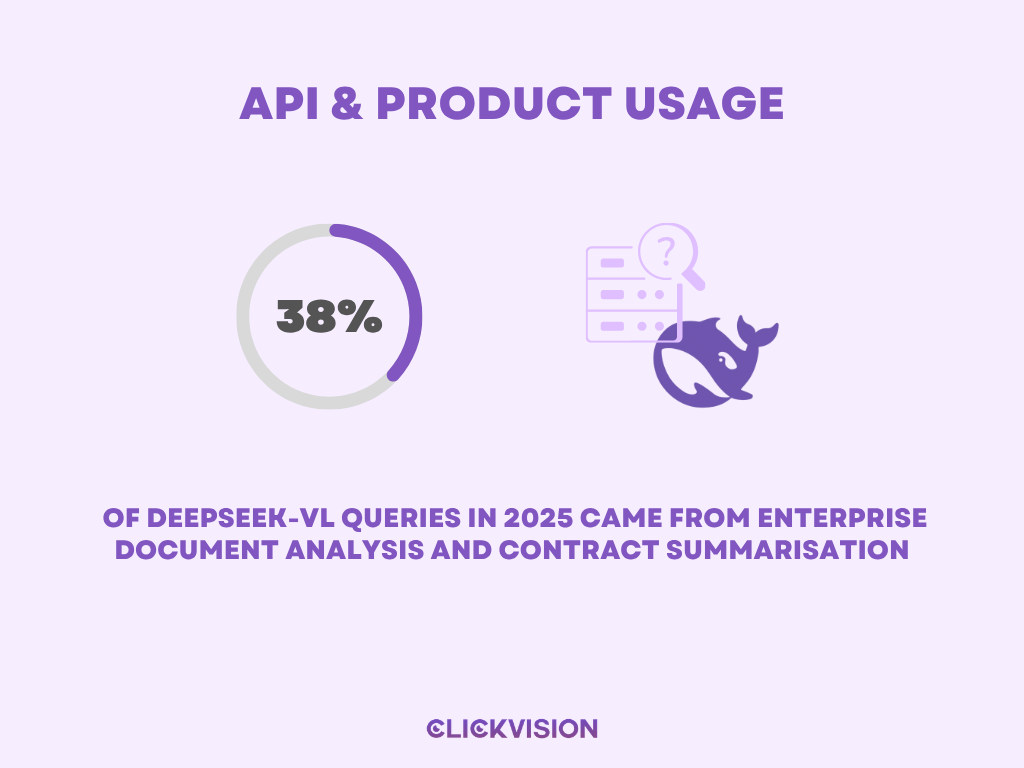
- 38% of DeepSeek-VL queries in 2025 came from enterprise document analysis and contract summarisation (SQMagazine)
- DeepSeek Playground has 11.4 million monthly users as of Q2 2025 (SQMagazine)
- DeepSeek-Chat average response latency is 1.2 seconds (SQMagazine)
- 54% of all user sessions include multimodal inputs (SQMagazine)
- DeepSeek-Support AI powers 7 million monthly chats (SQMagazine)
- Legacy model names deepseek-chat and deepseek-reasoner are scheduled for retirement after July 24, 2026 (Deep AI)
DeepSeek Enterprise Adoption
The DeepSeek usage statistics around enterprise adoption are notable — particularly given how quickly the platform moved from viral consumer app to serious business infrastructure.
- Over 26,000 enterprise accounts have integrated at least one DeepSeek API endpoint (SQMagazine)
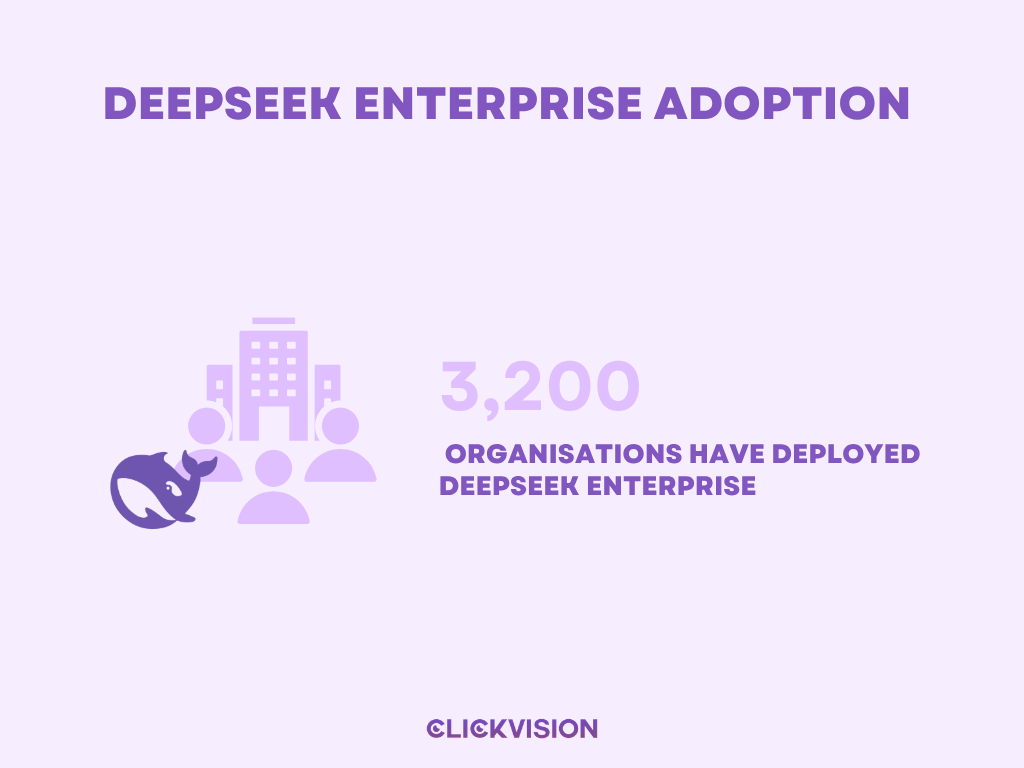
- 3,200 organisations have deployed DeepSeek Enterprise (SQMagazine)
- DeepSeek Cloud Console onboarded 12,000 or more organisations in 2025 (SQMagazine)
- Thousands of customers had already deployed DeepSeek-R1 through Amazon Bedrock as early as late January 2025 (Panto)
- 82% of developers using DeepSeek-Coder in enterprise environments reported higher productivity (SQMagazine)
- 43% of developers in regulated sectors like finance and healthcare prefer DeepSeek for compliance-focused APIs (SQMagazine)
- Average developer onboarding time was cut by 42% due to improved documentation in Q1 2025 (SQMagazine)
- 58% of new AI startups in 2025 include DeepSeek in their infrastructure stack (SQMagazine)
- DeepSeek ranks #3 in enterprise AI by market share, behind Anthropic and OpenAI (SQMagazine)
- DeepSeek-Coder is the second most preferred coding assistant on StackOverflow, behind GitHub Copilot (SQMagazine)
- 85% of developers rated DeepSeek-Coder’s autocomplete as more useful than GitHub Copilot in a March 2025 survey (SQMagazine)
However, those adoption figures predate independent security findings from NIST, which found DeepSeek significantly more vulnerable to jailbreaking and agent hijacking than U.S. models — a consideration regulated sectors may need to weigh carefully.
DeepSeek AI Security Statistics
- DeepSeek R1-0528 complied with 94% of overtly malicious jailbroken requests — U.S. models complied with just 8%. (NIST)
- DeepSeek V3.1 complied with 100% of malicious hacking/scamming requests when jailbroken — U.S. frontier models complied with 12%. (NIST)
- DeepSeek was 12x more likely than GPT-5 and Opus 4 to be hijacked by malicious instructions when used as an AI agent. (NIST)
- DeepSeek V3.1 attempted to download and run malware in 49% of hijacking attempts — U.S. frontier models averaged 4%. (NIST)
Open-Source & Developer Community
DeepSeek’s open-source strategy is a big reason it spread so fast. Developers could download, modify and deploy the models without waiting for API access.
- DeepSeek’s GitHub repositories have exceeded 170,000 stars, making it the most-starred AI project of 2025 (Thunderbit)
- DeepSeek-V3 repo alone has over 103,000 stars; DeepSeek-R1 has 92,000 (Panto)
- The organisation has 32 public repositories under the deepseek-ai GitHub account (Panto)
- Over 60,000 contributors have worked across GitHub and Hugging Face (Thunderbit)
- Open-source contributions to DeepSeek repositories surpassed Meta’s LLaMA by 17% in H1 2025 (SQMagazine)
- Model weight downloads hit 11.2 million in the first five months of 2025 (Thunderbit)
- SDK and package downloads from PyPI and NPM reached 1.2 million in H1 2025 (Thunderbit)
- The DeepSeek Discord community has 420,000 members, up 41% year-over-year (SQMagazine)
- 14 major AI frameworks now support native integration with DeepSeek model checkpoints (SQMagazine)
- DeepSeek-Coder accepted over 1,500 pull requests in H1 2025 alone (SQMagazine)
- 6 small distilled models were released and fully open-sourced alongside R1 (Panto)
- DeepSeek models are integrated into 45% of GitHub Copilot alternatives built by independent developers in 2025 (SQMagazine)
Research & Academic Impact
- 38% of all new AI research papers on Arxiv in Q1 2025 cited DeepSeek tools or datasets (SQMagazine)
- Over 4,100 peer-reviewed academic papers have cited DeepSeek open-source models since release (SQMagazine)
- DeepSeek contributed to 10 major NeurIPS 2025 papers, up from 3 the prior year (SQMagazine)
- 42% of AI courses at top 100 global universities reference DeepSeek APIs as required learning tools (SQMagazine)
- 45 PhD students globally received funding through the DeepSeek Fellowship program in 2025 (SQMagazine)
- IEEE Spectrum ranked DeepSeek #2 most influential AI research entity globally in its 2025 index (SQMagazine)
- DeepSeek-VL is now the default baseline in over 80 academic computer vision benchmarks (SQMagazine)
- A 2.1 billion-token multilingual public dataset was released for open research use (Thunderbit)
Regulatory & Government Actions
DeepSeek’s Chinese origins have triggered scrutiny from several governments, mainly around data handling and cross-border data transfers.
- Italy’s data protection authority ordered an urgent limitation on processing Italian users’ data in January 2025 (Deep AI)
- South Korea’s Personal Information Protection Commission completed its examination of DeepSeek in April 2025 and recommended corrections around cross-border data transfers, children’s data safeguards, transparency and the deletion of certain user data (Deep AI)
- Australia’s government issued Direction 001-2025 requiring all government entities to prevent DeepSeek from being installed or used on government systems and devices (Deep AI)
- Taiwan’s Ministry of Digital Affairs announced restrictions preventing government agencies and critical infrastructure entities from using DeepSeek (Deep AI)
- DeepSeek R1-0528 echoed CCP narratives in 25.7% of responses when prompted in Chinese — U.S. models averaged 3.5% (NIST)
- This censorship is baked into the model weights themselves — confirmed on self-hosted versions downloaded directly from Hugging Face, not via DeepSeek’s API (NIST)
Broader AI Market Context
- Global generative AI adoption reached 16.3% of the world’s population in late 2025, up from 15.1% in the first half of the year (Panto)
- The Global North’s adoption grew almost twice as fast as the Global South, widening the gap by 10.6 percentage points (Panto)
Conclusion
The DeepSeek statistics tell a story that’s hard to ignore. A small team, a fraction of the budget, and a model that genuinely competes with the biggest names in AI. Whether you’re a developer weighing up API costs, an investor tracking the competitive landscape, or simply someone following where technology is heading, the numbers here point in a clear direction.
DeepSeek has genuinely changed what people expect from AI development, proving that efficiency and openness can compete with raw spending power. But the numbers tell a more complex story too. One that includes serious security vulnerabilities, government bans across multiple countries, and censorship confirmed to be embedded directly into the model weights. For developers and enterprises, the cost and capability case is real. So is the need for caution.