
AI has stopped being a competitive advantage in lead generation – it’s becoming the baseline. The numbers now make that case definitively: businesses using AI in their pipeline workflows are capturing more leads, at lower cost, with higher conversion rates than those relying on manual processes.
This article consolidates every credible AI lead generation statistics available on AI lead generation – from chatbot adoption rates and conversion lifts to automation ROI and executive sentiment – into one authoritative, data-dense resource. Whether you’re benchmarking your own stack, building a business case for AI investment, or researching the space for a report, this is the most complete dataset currently available.
Here’s what’s covered:
- AI adoption in lead generation and marketing
- Chatbot lead generation performance statistics
- Marketing automation impact on lead volume and quality
- AI chatbot efficiency and cost metrics
- Generative vs. predictive AI usage rates
- Executive and marketer sentiment data
- Forward-looking projections through 2026 and beyond
AI Adoption in Lead Generation and Marketing
The shift toward AI-powered lead generation is no longer emerging – it’s mainstream. Across industries, organizations of every size are embedding AI into their marketing stacks, from prospecting tools and CRM integrations to automated nurture campaigns and chatbot deployments. What’s striking isn’t just the scale of adoption – it’s the speed. Platforms that were considered experimental two years ago are now standard operating procedure for competitive marketing teams. The statistics below capture exactly where the market stands today and where investment is heading next.
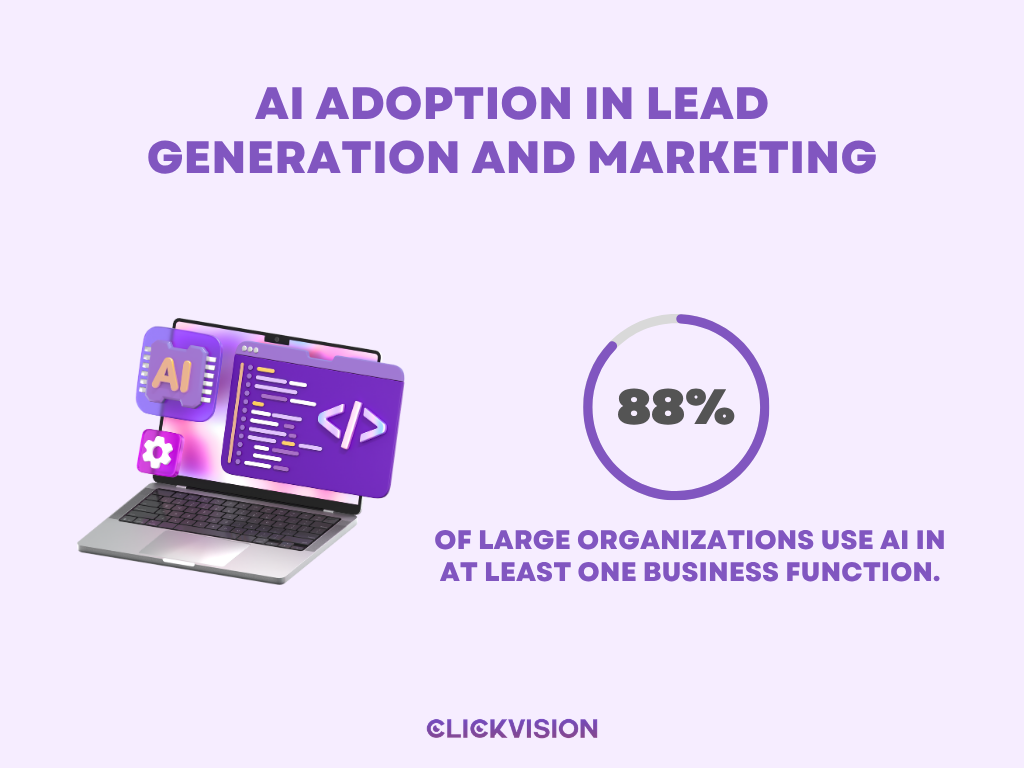
- 88% of large organizations use AI in at least one business function.
- 92% of marketers say AI has already impacted their role, including lead generation workflows.
- 79% of marketers expect to incorporate more AI into their strategies going forward.
- 80% of Fortune 500 companies are already using generative AI tools like ChatGPT internally.
- 20% of marketers plan to use AI agents specifically for marketing automation in 2025.
- 80% of marketing and sales leaders either have deployed or plan to deploy chatbots.
- 75%+ of companies use some form of marketing automation.
- 92% of marketing agencies invest in marketing automation tools.
- 80% of marketers say marketing automation software generates more leads and conversions for them.
- 98% of marketers plan to enhance webinars with AI in the next year.
- 1 in 4 marketers plan to leverage AI to convert text into multi-modal campaigns.
- 30% of marketers are actively considering predictive lead scoring powered by AI within the next two years.
AI Lead Generation Performance Statistics
Numbers on adoption tell you who’s using AI. Performance data tells you why they won’t stop. The ROI case for AI in lead generation is now backed by enough evidence across enough companies to move from anecdote to benchmark. Teams using AI throughout the funnel – for prospecting, scoring, outreach, and nurturing – are seeing gains on every core metric: lead volume, lead quality, conversion rate, cost per acquisition, and sales team productivity. The figures below represent the clearest performance picture available from current research.
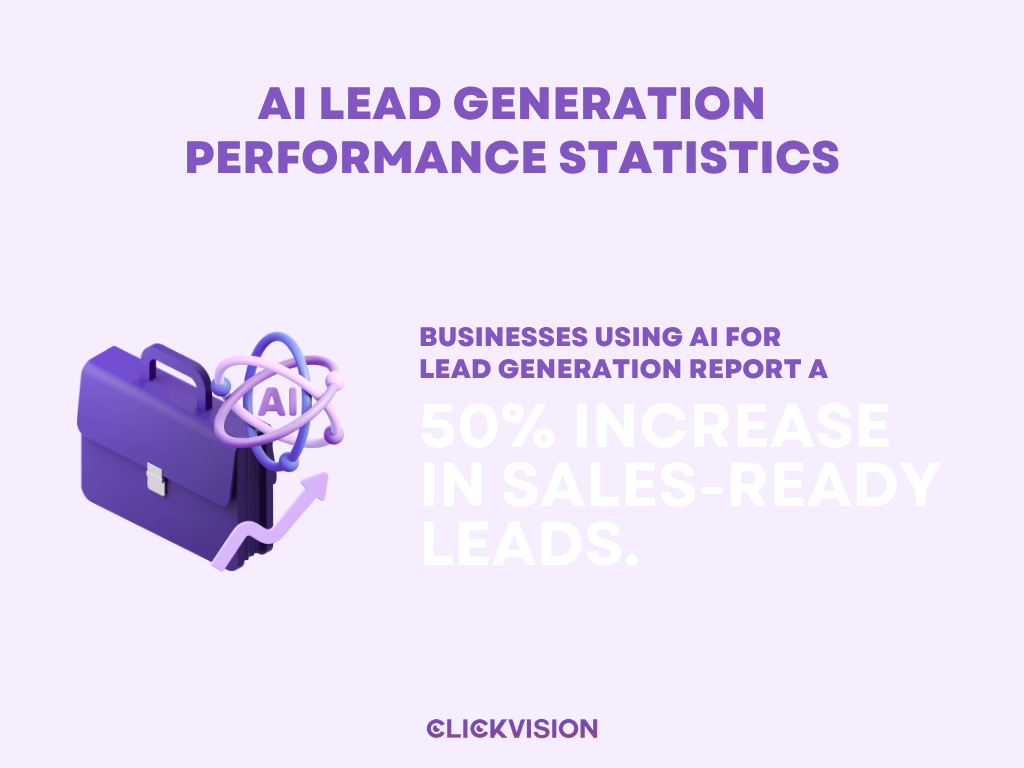
- Businesses using AI for lead generation report a 50% increase in sales-ready leads.
- AI-powered lead generation delivers up to 60% lower customer acquisition costs.
- AI lead scoring boosts conversion rates by 30%.
- Marketers leveraging AI-driven personalization were 215% more likely to report success in generating new leads.
- Companies using marketing automation with prospects see up to a 451% increase in qualified leads.
- AI assistants can double the number of sales meetings scheduled.
- Engaging a lead within 5 minutes makes them 9 times more likely to convert – a response speed only achievable at scale through AI.
- Multi-channel campaigns (often AI-orchestrated) increase engagement by 24%.
- Marketing automation leads to a 14.5% improvement in sales productivity.
- 55% of businesses using generative AI for lead generation report getting better quality leads.
AI Chatbot Lead Generation Statistics
Chatbots have crossed from novelty to infrastructure. What started as a simple FAQ widget has evolved into a sophisticated, AI-powered engagement layer capable of qualifying prospects, booking demos, and nurturing cold leads – all without human intervention. For B2B teams especially, where the gap between a site visitor and a sales conversation is often too wide to bridge manually at scale, chatbots are closing that gap in real time. The data below covers adoption, lead impact, customer behavior, cost efficiency, and market trajectory.
Adoption Rates
The deployment of chatbots is accelerating across sectors, with B2B companies leading the charge. The gap between B2B and B2C adoption rates reflects the particular value chatbots provide in longer, more complex sales cycles where initial qualification and immediate responsiveness are critical. As more businesses see competitors capturing leads through automated chat, adoption pressure will only increase – and the window for early-mover advantage is narrowing.
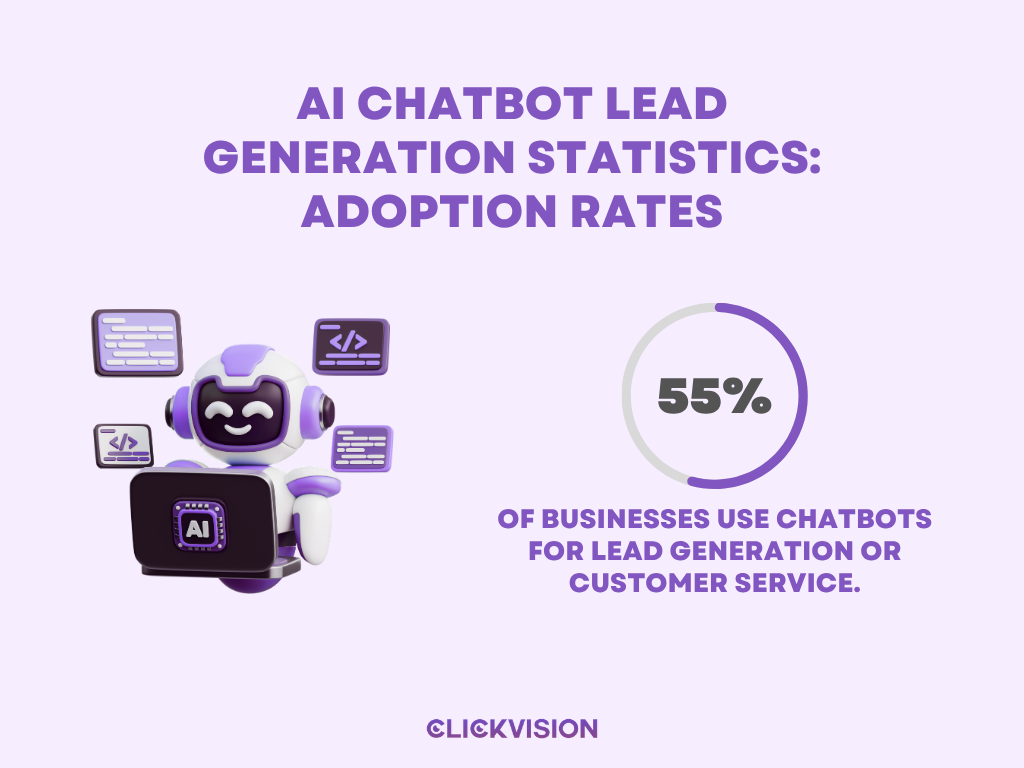
- 55% of businesses use chatbots for lead generation or customer service.
- 58% of B2B companies use chatbot software in some capacity, versus approximately 42% of B2C companies.
- 33% of businesses now use live chat or chatbots on their website to generate leads.
- 36% of marketers are currently using AI chatbots to handle day-to-day marketing tasks.
Lead Quality and Volume Impact
Chatbots don’t just capture contact information – the best AI-powered implementations actively qualify, segment, and prioritize leads before a human ever gets involved. This upstream filtering is what makes chatbots so valuable to sales teams: reps receive warmer, better-contextualized leads rather than raw form fills. When a chatbot asks the right questions at the right moment – about budget, timeline, or use case – it’s performing the same function as a top-of-funnel SDR, around the clock. The performance data here reflects that distinction clearly.
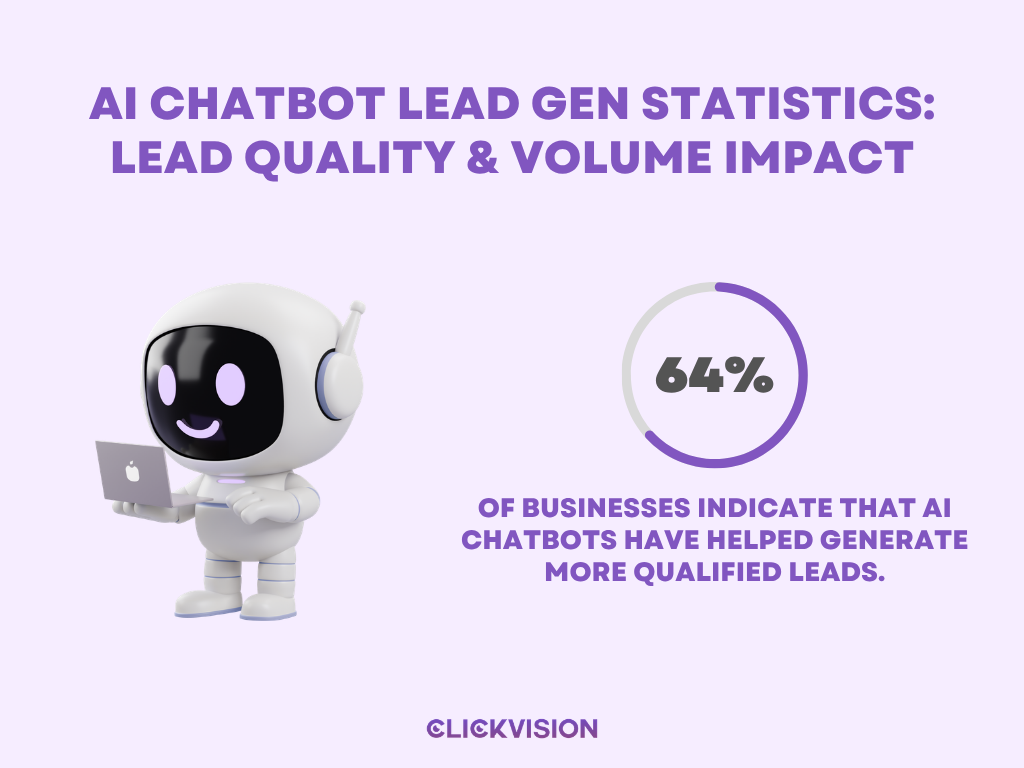
- 64% of businesses indicate that AI chatbots have helped generate more qualified leads.
- 55% of marketing and sales leaders who use chatbots report an increase in high-quality lead volume.
- 26% of B2B companies using live chat or chatbots report a 10–20% increase in lead volume.
- Real-time chatbot interaction has boosted conversion rates by up to 20% in B2B settings.
- With AI chatbots, 64% of support agents handle mostly complex issues, compared to 50% without chatbots – freeing human reps for higher-value conversations.
Customer Acceptance and Behavior
One of the most common objections to chatbot deployment is the fear that prospects will find automated conversations impersonal or frustrating. The data here dismantles that assumption entirely. Buyer preferences have shifted considerably – shaped by years of on-demand digital experiences – and what customers want most from an initial interaction isn’t a human voice, it’s an immediate and accurate one. Understanding this shift is essential for any organization still hesitating on chatbot investment due to perceived brand risk.
- 82% of consumers prefer an immediate response from a chatbot over waiting for a human representative.
- 96% of consumers feel that businesses using chatbots are demonstrating a commitment to good service.
Cost and Efficiency
The economics of chatbot deployment are among the clearest in all of marketing technology. Unlike many AI tools where ROI requires careful modeling and attribution work, chatbot cost efficiency is straightforward: automated conversations cost a fraction of human interactions, and the savings scale directly with volume. For high-traffic websites and high-touch sales processes, this arithmetic becomes irresistible. The efficiency gains below don’t account for the additional revenue generated from leads captured – making the true ROI substantially higher than the cost figures alone suggest.
- Automated chatbot conversations cost approximately $0.50 per interaction, compared to $6.00 per human support session.
- Companies can save up to 30% on customer support costs by implementing chatbots – with lead generation benefits layered on top.
Market Growth
The scale of investment flowing into the chatbot market reflects the confidence the industry has in AI-powered conversational tools as a long-term foundation – not a passing trend. Near-tripling of the market in five years suggests that current adoption rates, already significant, represent only the early phase of a much broader deployment curve. Vendors are investing heavily in AI model improvements, deeper CRM integrations, and multi-platform deployment – meaning the tools available in 2027 will be substantially more capable than what’s on the market today.
- The global chatbot market is projected to grow from $15.6 billion in 2024 to $46 billion by 2029 – nearly tripling in five years.
Generative AI vs. Predictive AI in Lead Generation
Not all AI in lead generation works the same way. Generative AI – tools that produce content, copy, conversation, and creative output – sits at a different point in the adoption curve than predictive AI, which uses historical data to forecast behavior, score leads, and identify patterns. Understanding where marketers stand on each type reveals a lot about the current maturity of AI in the industry and where the next wave of competitive advantage will emerge. The gap between these two categories isn’t just a technology preference – it reflects deeper organizational comfort levels with data-driven decision-making versus content-driven execution.
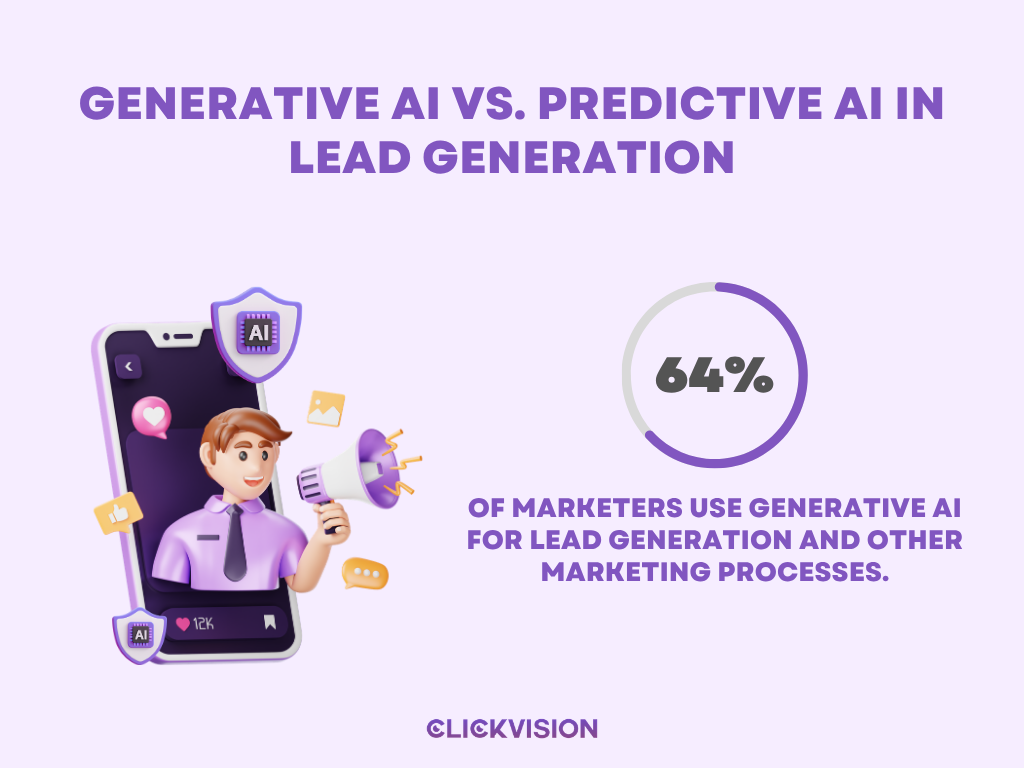
- 64% of marketers use generative AI for lead generation and other marketing processes.
- 35% are trialing or planning to trial generative AI within the next 18 months.
- 54% of marketers use predictive AI.
- 42% are currently piloting or intending to pilot predictive AI within the next 18 months.
- 41% of marketers use AI in their lead magnet follow-up automations.
- 32% of marketers create nurture sequences based on user behavior with AI.
- 41% would consider AI investment specifically for personalizing the customer experience.
- 72% of marketers agree that AI and automation tools like chatbots help them personalize customer experience across multiple levels.
Executive Sentiment on AI and Lead Generation
C-suite and senior leadership buy-in is the single largest accelerant or blocker of AI adoption within organizations. When executives understand AI’s role in pipeline generation – not just as a cost-saving tool but as a revenue driver – investment follows. What the data shows is that this understanding has largely arrived. Senior leaders are no longer asking whether AI impacts lead generation; they’re asking how to maximize that impact. For marketing teams seeking budget approval for AI tools and infrastructure, the executive sentiment data below represents a favorable climate that didn’t exist just two years ago.
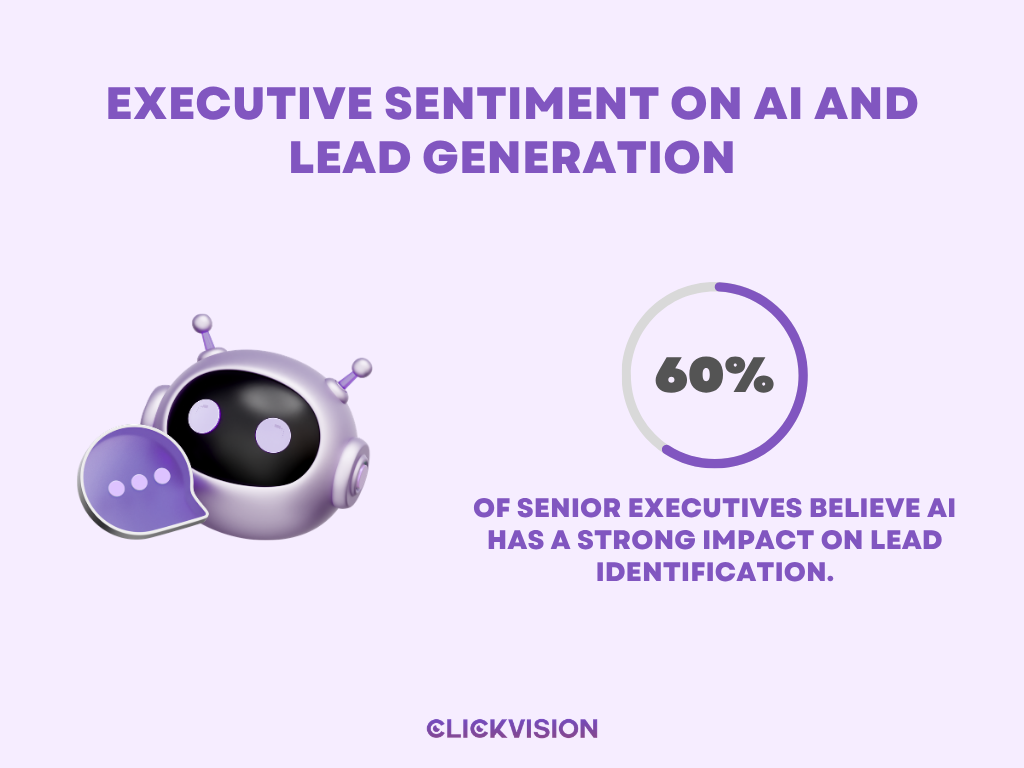
- 60% of senior executives believe AI has a strong impact on lead identification.
- 78% of buyers need more tailored content, and 75% of organizations are leveraging AI to meet those expectations.
- 92% of marketers say AI has already impacted their role, with lead generation workflows among the most affected areas.
Forward-Looking Projections: 2026 and Beyond
Looking ahead, the data points to a world where AI isn’t supplementing lead generation – it’s running it. The projections here aren’t speculative; they’re extrapolations from current investment trajectories, adoption curves, and technology development timelines. For marketing and sales leaders building strategies for the next 12 to 24 months, these numbers represent the environment you’ll be operating in – and competing against. Teams that treat these projections as distant forecasts rather than near-term planning inputs risk being structurally underprepared when the inflection points arrive.
- In 2026, AI-powered agents are projected to handle up to 95% of customer interactions, delivering fast, personalized support 24/7.
- The virtual events industry (a key lead gen channel) is projected to exceed $100 billion by 2032.
- By 2026, a chatbot or virtual assistant is expected to be a standard component of every B2B sales team.
First-Party Data and Privacy Context
AI lead generation doesn’t operate in a vacuum – it operates on data. And the data landscape is changing significantly. As third-party tracking erodes under regulatory pressure and browser-level restrictions, the quality and ownership of an organization’s own data becomes the foundation on which every AI model, scoring algorithm, and personalization engine is built. The organizations that invested early in robust first-party data infrastructure will have a decisive advantage as privacy constraints tighten. The statistics below show how marketers are navigating this shift – and where the gaps remain.
- In 2022, 40% of B2B marketers ranked first-party data collection as their leading response to data privacy challenges.
- By 2023, only 27% said they were prioritizing first-party data solutions – a significant drop reflecting competing strategic priorities.
- As third-party cookies are phased out, first-party data is becoming increasingly critical for AI-powered personalization and lead targeting.
- 61% of marketers say generating quality leads is their top challenge heading into 2026.
Key Patterns and Insights From the Data
Several consistent signals emerge when you look across the full dataset:
AI doesn’t just generate more leads – it filters better ones.
The 30% conversion lift from AI lead scoring, combined with the 64% of businesses reporting higher-quality leads from AI chatbots, shows that AI’s impact on quality is as significant as its impact on volume. Volume without quality is noise; AI addresses both simultaneously.
Cost reduction is as compelling as revenue growth.
A 60% reduction in customer acquisition costs is not a marginal efficiency gain – it fundamentally changes unit economics for sales and marketing teams. When you pair that with a 50% increase in sales-ready leads, you’re looking at a scenario where teams generate more from less – the ideal outcome for any growth operation under budget pressure.
Generative AI is winning the adoption race over predictive AI.
With 64% using generative AI versus 54% using predictive AI, marketers are more comfortable using AI to create and engage than to forecast. This gap will likely narrow as predictive tools mature and more marketers recognize that personalized content without smart targeting only gets you halfway.
Chatbot economics are hard to ignore.
At $0.50 per conversation versus $6.00 for human support, chatbots pay for themselves quickly – and every lead they capture is nearly pure upside. The 30% support cost savings create a reinvestment pool that sharp teams are channeling directly back into lead generation infrastructure.
Speed remains the underrated variable.
The 9x conversion lift from responding to a lead within 5 minutes underscores why AI-powered instant engagement matters. No human team can consistently hit that window at scale without automation. Speed-to-lead is no longer a best practice – it’s a mathematical imperative backed by data.
Conclusion
The data collected here tells a single coherent story: AI has moved from an experimental tool to a structural component of high-performing lead generation operations. The gains are measurable – 50% more sales-ready leads, 60% lower acquisition costs, 451% more qualified leads from automation, and chatbot conversations at a fraction of the cost of human interactions.
For marketers, the question is no longer whether to adopt AI in lead generation – it’s how fast and how well. Those integrating AI across prospecting, chatbot engagement, lead scoring, and nurture automation are compounding advantages that purely manual teams cannot replicate.
This dataset will be updated as new data becomes available. If you’re building a lead generation strategy for 2026, bookmark this page as your benchmark.
If your team is ready to move beyond manual prospecting and build a scalable pipeline, explore our lead generation services to see how strategic outreach, automation, and qualification can turn more prospects into revenue opportunities.
Sources
- Warmly – 40 Key Lead Generation Statistics You Should Know in 2026
- Oracle – Top Marketing Automation Statistics
- Hubspot – The State of Marketing
- Sales Force – State of Marketing
- Mail Vendor Selection – 67+ Lead Generation Statistics & Trends (2026)
- HubSpot’s 2025 State of Sales Report: What 1,000+ sales pros say about AI, buyer behavior, and growth
- G2 – Lead Generation Statistics for 2026: Key Marketing Data
- Martal Group – 2026 Lead Generation Statistics: From Insights to Impact
- Wyzowl – Video Marketing Statistics 2026
- First Page Sage – Conversion Rate By Channel
- Wpromote – 2023 State of B2B Digital Marketing
- Hubspot – Marketing Statistics Every Team Needs to Grow in 2026
- Improvado – AI Lead Generation: The Complete Guide to Scaling Growth in 2026
- HBR – The Short Life of Online Sales Leads
- Cases – The Chatbot Market In 2024: Forecasts and Latest Statistics