
AI job displacement statistics are no longer about the distant future. They describe what is already unfolding inside companies, industries, and labor markets right now.
Between 2025 and 2030, artificial intelligence and automation will reshape how work is done, which roles disappear, which new ones emerge, and — most critically — who benefits and who falls behind. Headlines swing between panic (“millions of jobs lost”) and optimism (“AI creates more jobs than it destroys”), but neither extreme tells the full story.
This guide cuts through the noise. By merging the most credible research, reports, and forecasts, you’ll get a clear, data-driven picture of AI job displacement vs creation, where automation risk is highest, and how the transition is really playing out.
AI Job Displacement Statistics at a Glance (2025–2030)
Before getting lost in headlines about “jobs replaced by AI,” it’s important to ground the conversation in what the most credible data actually shows. AI job displacement statistics vary widely depending on how researchers define automation, exposure, and job loss — but across institutions, a consistent pattern is emerging.
The figures below represent the most frequently cited, cross-validated estimates from global organizations, academic research, and labor market analyses. Together, they capture not just how many jobs AI may displace between 2025 and 2030, but also how many new roles are expected to emerge — and why the transition period matters more than the final totals.
Rather than predicting mass unemployment, these statistics reveal a deeper shift: widespread task-level automation, uneven disruption across sectors, and a growing gap between job displacement and job accessibility.
Before diving deeper into industry-specific impacts and timelines, here’s a clear snapshot of the numbers shaping the global AI employment debate.
- 85–92 million jobs displaced globally by 2030, depending on scenario (World Economic Forum)
- 97–170 million new jobs created, resulting in net job growth worldwide (World Economic Forum)
- 30% of U.S. jobs could be automated by 2030, at least partially (National University)
- 60% of jobs will experience significant task-level changes due to AI (National University)
- 11.7% of U.S. jobs are already technically automatable today (Exploding Topics)
- 14% of the global workforce may be forced to change careers by 2030 (McKinsey)
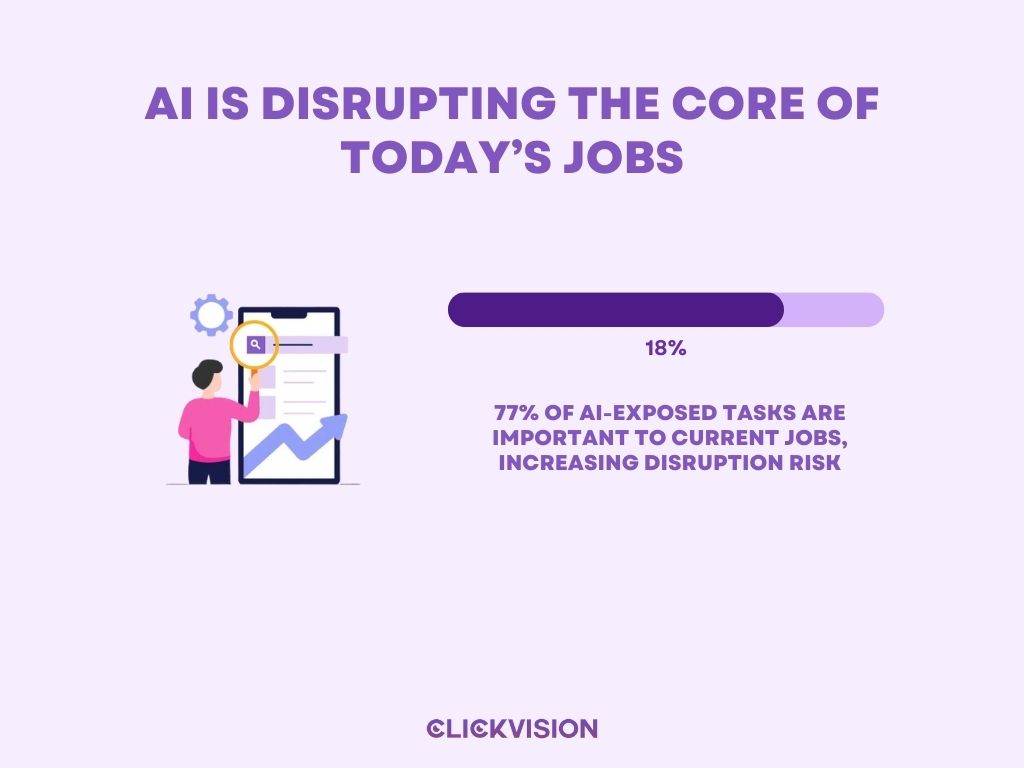
- 77% of AI-exposed tasks are important to current jobs, increasing disruption risk (Pew)
What “AI Job Displacement” Actually Means (and What It Doesn’t)
One major reason AI job displacement statistics are confusing is that different studies measure different things. Headlines often collapse multiple concepts into the single idea of “jobs being replaced,” even though most real-world AI impact happens inside jobs, not instead of them.
Understanding these distinctions is critical. Without them, statistics about automation risk are easy to misread—and often exaggerated.
Job Displacement vs Task Automation vs Job Exposure
- Job displacement: A role is eliminated or headcount is permanently reduced because AI or automation makes the position economically unnecessary.
- Task automation: Specific tasks within a job are automated, but the role itself continues to exist—often with higher output expectations or fewer people performing it.
- Job exposure: A job contains tasks that AI can assist with or perform, even if full automation is not technically or economically viable.
Most AI job displacement statistics refer to task-level exposure, not full job replacement. This matters because automation typically unfolds in stages: tasks are automated first, roles are compressed next, and only then—if productivity gains outweigh redeployment opportunities—are jobs eliminated.
In practice, this means workers are more likely to experience job transformation, wage pressure, or slower hiring long before outright displacement occurs.
AI Job Displacement vs Creation Statistics (2025)
One of the most important — and most misunderstood — findings across AI labor market research is that AI simultaneously destroys and creates jobs. This dual effect is often presented as reassurance, but the details matter far more than the headline numbers.
According to joint analyses cited by the World Economic Forum, AI and automation could displace approximately 85–92 million jobs globally by 2030, while creating 97–170 million new roles over the same period. On paper, this results in net job growth worldwide.
However, this net positive outcome exists only at the macroeconomic level. It does not describe how smoothly individual workers transition from declining roles into newly created ones.
The Catch: Accessibility and Mismatch
The problem is not job creation — it’s who can realistically access those jobs, and how quickly.
- Most new AI-driven roles demand advanced technical or analytical skills
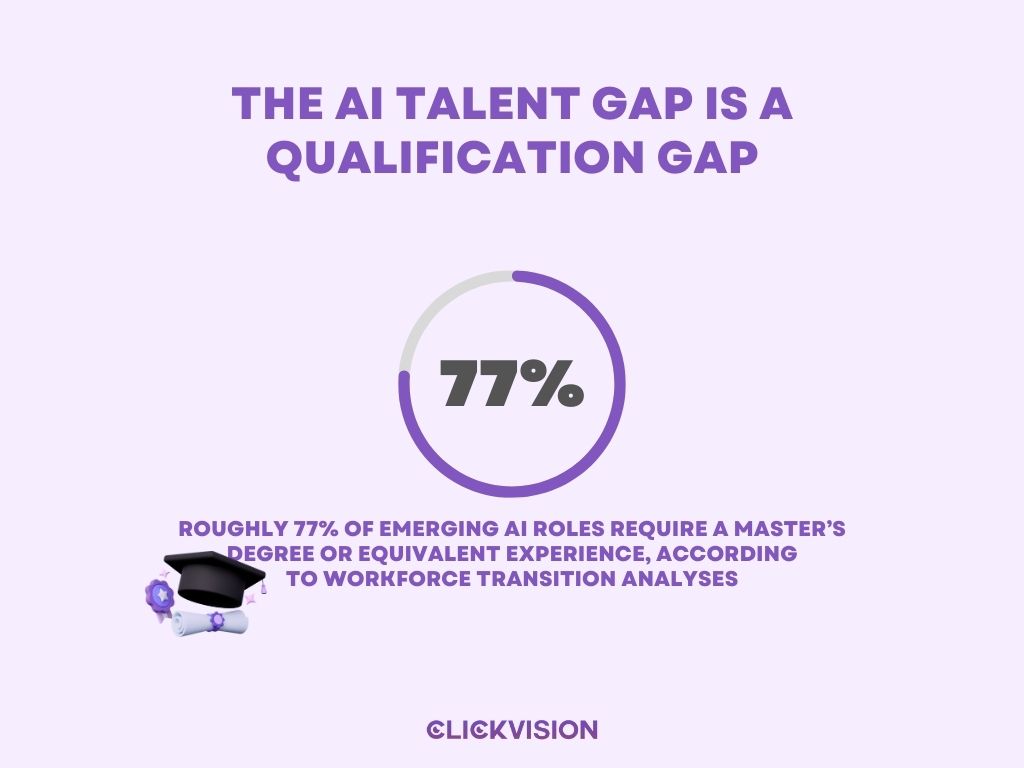
- Roughly 77% of emerging AI roles require a master’s degree or equivalent experience, according to workforce transition analyses (AI Job Displacement Analysis)
- Job creation is heavily concentrated in technology, data science, AI operations, cybersecurity, and high-skill professional services
As a result, many displaced workers face skills mismatches, geographic constraints, and credential barriers that prevent direct movement into new roles.
This is why net positive employment does not equal smooth workforce transitions. In practice, AI-driven job creation often lags displacement, favors a narrower segment of workers, and intensifies inequality during the adjustment period.
AI Automation Job Displacement Statistics by Sector
AI’s impact on job displacement is highly uneven. Automation does not spread uniformly across the economy — it concentrates first where work is repetitive, rules-based, and digitally mediated. Sector-level data makes this clear.
For content teams, the relevant productivity gain is time saved on publication-ready work after fact-checking and editing — not simply the speed of generating a draft. Our AI writing statistics bring together broader research on AI-assisted writing.
High-Risk Sectors (2025–2027)
These sectors face the fastest and most direct displacement, largely because AI systems can already perform a large share of core tasks at lower cost and higher speed.
- Customer service & call centers: Up to 80% automation potential, driven by AI chatbots, voice agents, and workflow automation replacing tier-1 support.
- Data entry & clerical roles: Among the most vulnerable occupations, with millions of jobs at risk by 2027 as document processing, form handling, and basic administration become fully automated.
- Retail cashiers & bank tellers: 60–65% automation exposure due to self-checkout, digital payments, and AI-powered banking interfaces.
- Basic content production: Rapid displacement from generative AI tools capable of producing routine text, summaries, product descriptions, and simple marketing assets.
These roles are typically affected before large-scale layoffs, through hiring freezes, role consolidation, and declining entry-level opportunities.
Medium-Risk Sectors (2027–2030)
In these sectors, AI tends to compress roles rather than eliminate them outright, reducing headcount over time as productivity per worker increases.
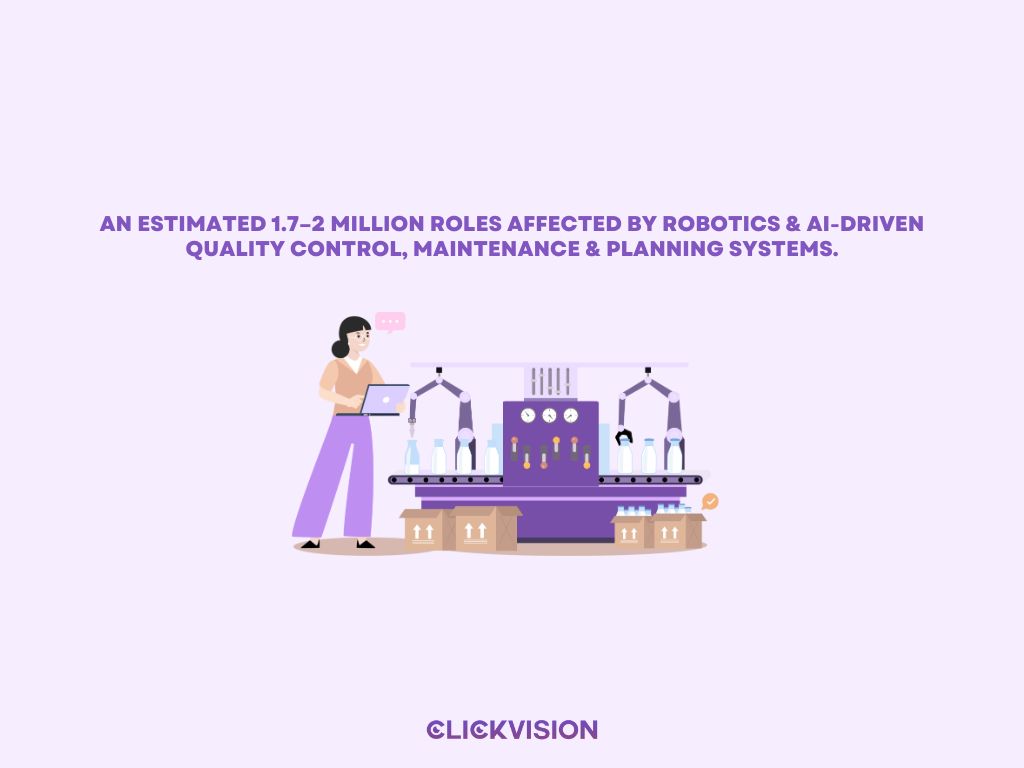
- Manufacturing: An estimated 1.7–2 million roles affected by robotics and AI-driven quality control, maintenance, and planning systems.
- Transportation & logistics: Autonomous and semi-autonomous systems pose a growing threat to long-haul trucking and warehousing, though regulatory and safety constraints slow full replacement.
- Accounting & back-office operations: AI-assisted analysis, reconciliation, and reporting reduce demand for junior and mid-level roles while increasing expectations for remaining staff.
Displacement in these sectors is typically gradual but cumulative, unfolding over several years.
Lower-Risk Sectors (for Now)
These sectors remain more resilient because they rely on physical presence, complex human interaction, or contextual judgment that AI struggles to replicate economically.
- Healthcare practitioners
- Skilled trades and construction
- Education (primarily augmented by AI, not replaced)
- Personal services and care work
Lower risk does not mean no impact — AI often changes how work is performed — but full job displacement is significantly less likely in the near term.
That assessment applies to the occupations listed, not every department in those industries: routine marketing work may still be exposed. For broader research on this business function, explore our AI marketing statistics.
Generative AI Job Displacement Statistics (2025–2030)
Generative AI accelerates change faster than traditional automation.
Research from MIT and OpenAI shows:
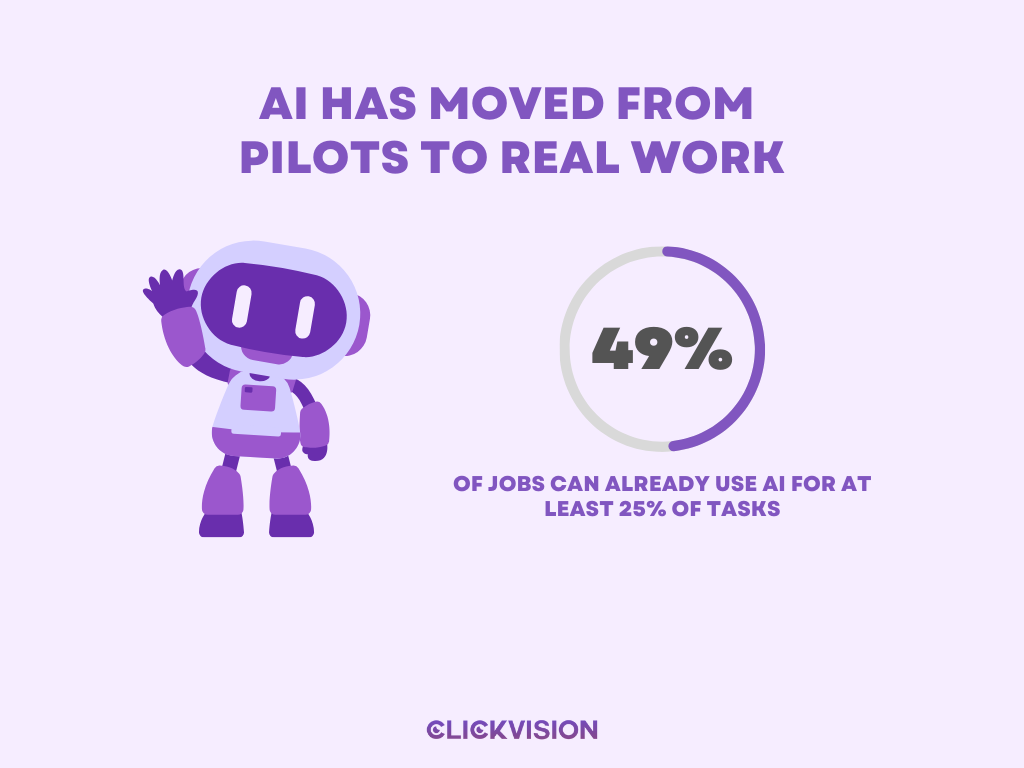
- 49% of jobs can already use AI for at least 25% of tasks (Anthropic)
- 19% of U.S. workers could see more than half of their tasks impacted (OpenAI)
- Generative AI excels at:
- Writing and summarization
- Customer interaction
- Coding assistance
- Data analysis and reporting
This explains why white-collar roles — once considered “safe” — are now among the most exposed. For platform-level context, our ChatGPT statistics collect research on the assistant; personal use, however, should not be confused with an employer automating a workplace process.
AI Job Displacement Statistics by Geography
AI-driven job displacement does not affect countries equally. Geographic differences in economic structure, labor composition, and technology adoption play a decisive role in determining where disruption arrives first — and where it hits hardest.
United States
In the U.S., AI job displacement is driven less by robotics and more by software-based automation and generative AI, which disproportionately affect white-collar and entry-level roles.
- 30% of U.S. jobs could be automated by 2030 (National University)
- 47% of workers face automation exposure over the next decade (Exploding Topics)
- Entry-level roles are disproportionately affected
In practice, this means disruption often appears as slower hiring, fewer junior openings, and higher output expectations, long before mass layoffs occur.
Advanced Economies vs Emerging and Low-Income Countries
According to the International Monetary Fund, exposure to AI automation is strongly correlated with a country’s income level and occupational mix:
- 60% of jobs in advanced economies are exposed to AI (Exploding Topics)
- 47% in emerging markets
- Only 26% in low-income countries (Exploding Topics)
This pattern may seem counterintuitive, but the explanation is structural rather than technological.
Advanced economies employ a much higher share of workers in administrative, professional, and cognitive roles — exactly the types of tasks AI systems can automate or augment most efficiently. In contrast, low-income economies rely more heavily on manual, informal, and agriculture-based work, which remains difficult for AI to replace economically.
Why Geography Shapes AI Job Displacement
Geographic differences reveal an important insight:
AI disrupts where digital work is concentrated, not where labor is cheapest.
As a result:
- Wealthier countries face earlier and faster task automation
- Emerging markets experience gradual compression rather than immediate displacement
- Low-income countries are less exposed today — but may face sharper shocks later as automation costs fall
Understanding these geographic dynamics helps explain why AI job displacement statistics often appear contradictory across regions.
Gender, Age, and Education: Who Is Most Exposed?
Gender Disparities
- Women are overrepresented in clerical, administrative, and service roles
- Tens of millions of women globally work in highly automatable jobs
Age
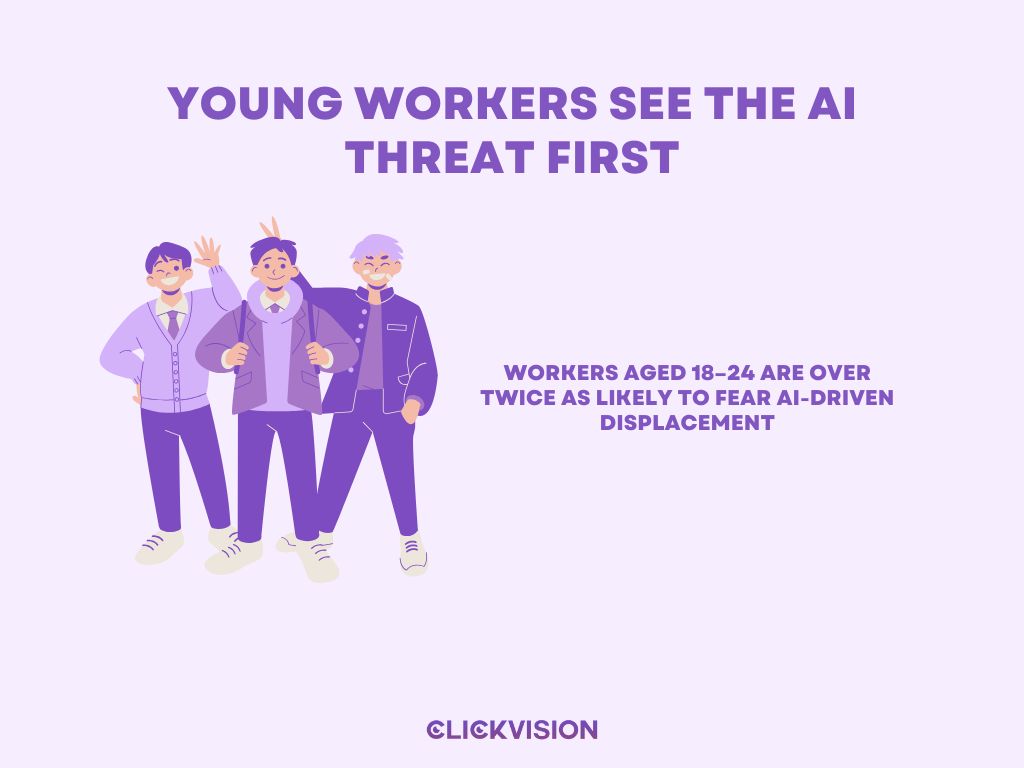
- Workers aged 18–24 are over twice as likely to fear AI-driven displacement (National University)
- Entry-level jobs — career launchpads — are shrinking fastest
Education Paradox
Data from Pew Research Center shows:
- 27% of workers with a bachelor’s degree or higher are in AI-exposed roles (Pew)
- Only 3% of workers without a high school diploma face similar exposure (Exploding Topics)
AI primarily disrupts educated, white-collar labor, not manual work.
AI Robotics Job Displacement Statistics (2025–2030)
Robotics-driven displacement continues in parallel with software AI:
- 1.7 million U.S. manufacturing jobs lost since 2000 (BuiltIn)
- Industrial robots increasingly handle:
- Assembly
- Quality control
- Warehouse logistics
- AI-enhanced robotics reduces error rates and labor costs
However, robotics adoption remains capital-intensive, slowing universal rollout.
The Real Risk: Career Bottlenecks, Not Mass Unemployment
Across all AI job displacement statistics, one pattern stands out:
AI doesn’t eliminate work — it eliminates tolerance for average performance.
Key consequences:
- Fewer entry-level roles
- Flatter organizations
- Higher output expectations per worker
- Wage pressure in mid-skill roles
- Winner-take-most labor markets
Employment rates may remain stable while career mobility declines.
An SEO team that automates routine reporting may also remove a junior employee’s opportunity to practice diagnosing problems. That lost experience needs a replacement, not just tool training; our AI SEO statistics provide broader research on AI in SEO.
Timeline: When AI Job Displacement Accelerates
- 2023–2025: Task automation, hiring freezes, role compression
- 2026–2028: Career transitions spike, displacement peaks
- 2029–2035: New equilibrium forms with fewer but more leveraged roles
This makes 2025–2030 the critical transition window.
What Workers and Businesses Should Do Next
For Workers
- Move upstream toward decision-making and problem framing
- Build AI literacy, not just tool familiarity
- Focus on skills AI complements, not replaces
For Businesses
- Invest in augmentation, not blind automation
- Reskill before displacement, not after
- Redesign roles instead of eliminating them prematurely
Automating prospect research may increase the number of leads needing follow-up. Before reducing staff, check whether the workload has moved to qualification or sales conversations. Our AI lead generation statistics provide broader research on AI-assisted lead generation.
Conclusion: Understanding AI Job Displacement Statistics Clearly
AI job displacement statistics are not a prophecy of mass unemployment. They are a warning about misalignment during rapid transition.
Between 2025 and 2030, millions of jobs will disappear — and millions more will emerge. The difference between losing out and moving ahead will come down to timing, skills, and access.
Understanding the data correctly is the first step.
If you found this guide useful, consider sharing it or exploring more insights on CLICKVISION.